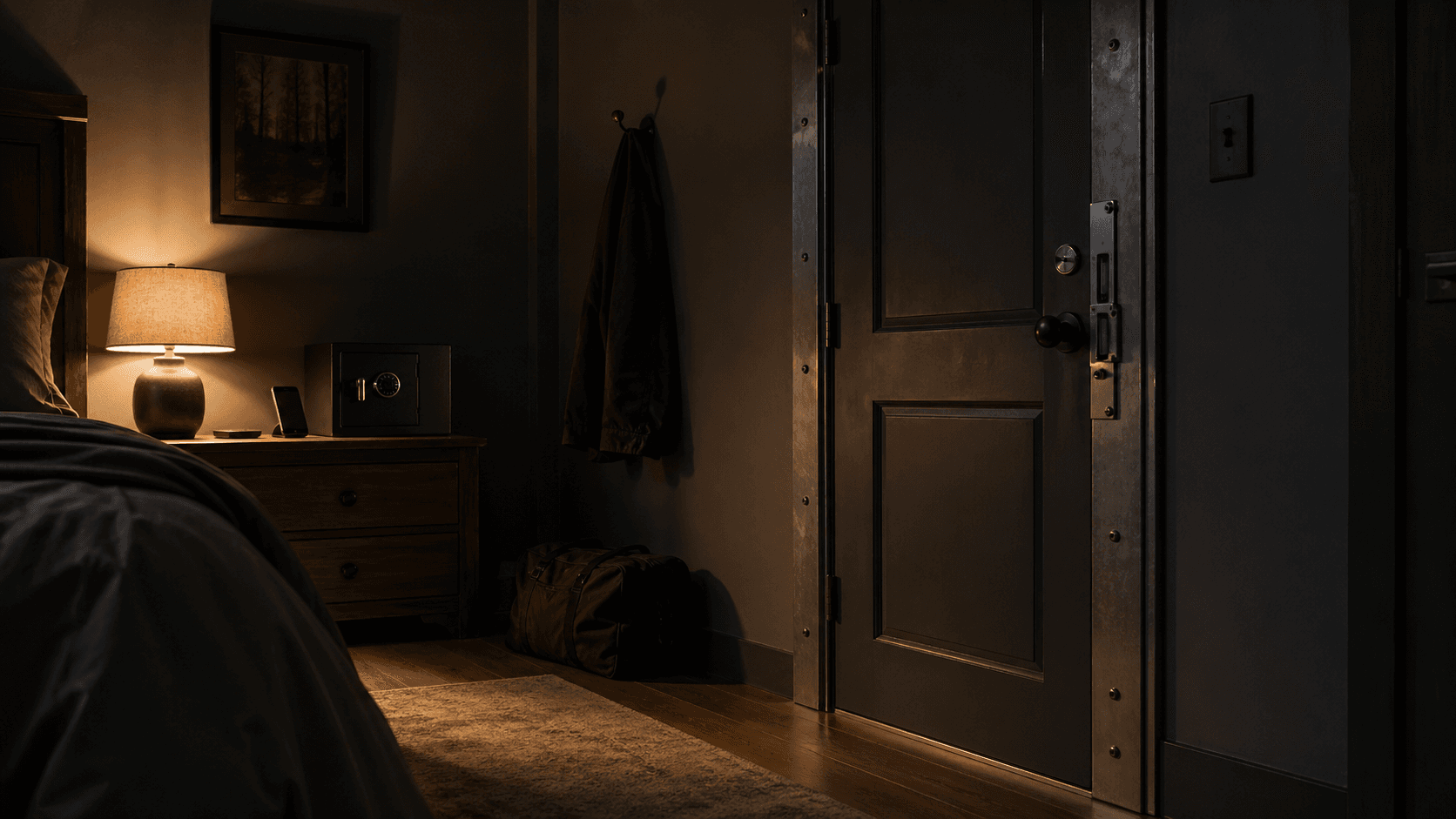
It's 2:47 a.m. Glass breaks downstairs. You're awake before your wife is. The dog is already growling at the bedroom door. Somewhere on the other side of that door, two men are inside your house, and the average burglary will be over before the responding officer is halfway to your address. What happens in the next ninety seconds is the only thing that matters, and it has almost nothing to do with what you do after you hear the glass. It has to do with what you built into that bedroom over the last six weekends.
That bedroom is your hard room. It is the last echelon in your defense in depth, the position you fall back to when deter, detect, and delay have all been compromised, and the position you defend until police arrive 11 minutes later in a dense suburb or 25-plus minutes later if you live where most of our customers actually live. Most home-defense writing skips this layer entirely or replaces it with a vault-room fantasy that 99% of homeowners will never spec, install, or use. This post is the practical version: how to take the master bedroom you already sleep in and turn it into a time-buying position that lets you communicate, identify, and defend.
In this article
- Hard Rooms: Designing Your Final Fallback Position
- Why the Hard Room Is the Missing Layer in Most Plans
- Site Selection: It's the Master Bedroom, With Caveats
- Door and Frame Hardening: The Entry Control Point
- The Communications Cache
- The Defensive Cache
- Cameras and Situational Awareness From Inside the Room
- Anti-Tamper: Panel Placement and Comms
- The Drill: What Happens at the Chime
- Spec Checklist: The Hard-Room Kit
- What Most "Panic Room" Content Gets Wrong
- Spec It Out With Us
Why the Hard Room Is the Missing Layer in Most Plans
Walk through the average prepper's home-defense plan and you'll find good thinking on the outside layers. Floodlights. Cameras. Door chimes. Maybe a dog. A pistol in the nightstand. What's missing is the doctrine that ties it all together: where do the people end up, and what do they do once they get there. Layers 1-4 — deter, detect, delay, deny — are designed to do one thing: buy you the seconds you need to consolidate the family in a defensible position with a working phone, working comms, working eyes on the threat, and a firearm you can actually use without shooting your own kid coming back from the bathroom.
The UNC Charlotte study by Joseph Kuhns (2012) surveyed 422 incarcerated burglars and produced the stat that sits behind everything we recommend: 60% of burglars will seek an alternative target if there is an alarm on-site, and roughly half will discontinue an attempt the moment they discover one mid-entry (UNC Charlotte). That's the deter and detect math. But the same study points to an uglier truth: a meaningful minority of offenders will press through the alarm. Add to that the violent home invasion — the kicked-in front door at dinnertime, the pretext knock at 6 a.m. — where the attacker already expects resistance and is moving fast. Police response is not coming inside the burglary's clock. It is coming after. Your job is to make sure "after" still has a family attached to it.
The hard room is where you survive the gap. For a refresher on how it sits inside the broader doctrine, start with our layered defense overview and the OODA loop and door chimes piece — those describe the early-warning side of the same fight.
Site Selection: It's the Master Bedroom, With Caveats
For 95% of homeowners, the hard room is the master bedroom. The reasons are tactical and boring. The adults who will respond to a 2 a.m. break-in are already inside it. The phone is on the nightstand. The firearm is in the bedside safe. If you've planned correctly, your kids' rooms are on the same floor and either close enough to reach in a five-second sweep or configured so the kids can come to you on a verbal cue.
What you want in a hard room:
- Interior placement, not over a porch or attached garage. Shared walls with the rest of the house mean an attacker can't approach from outside without triggering layers 1-3 first.
- One door in, no exterior door. If the master has a slider to the deck, that's a serious problem. Either the slider gets bar-locked, sensored, and curtained — or the hard room moves.
- Windows above eye level or with security film. Low windows that put a person on a knee-line outside the house are not what you want covering your sleep position.
- Line of sight to the bedroom door from your bed. If you can't see the entry from where you sleep, the room is wrong.
- Cellular signal. Test it on the floor next to your bed, not standing up. If the signal drops to one bar at floor level, you're going to fight that during the call to 911.
Avoid: any room with a sliding glass door, any room over an attached garage (an attacker in the garage is already inside your envelope), basements with one exit, and bonus rooms over a porch. The fatal funnel of a basement stairwell is not a position you want to defend with kids behind you.
Children's rooms are part of this calculus. The doctrine in our family is that on a chime or alarm, the kids either come to the hard room on a code word or stay put behind a locked door while the adult sweeps and brings them. That is a drill, not a hope. Spec the drill against the floor plan; if the geometry forces a 30-foot exposed sweep through a great room with full glass, change the plan, change the rooms, or change the layout. We'll link the full family-drill walkthrough at family drill: home-defense action plan.
Door and Frame Hardening: The Entry Control Point
The hard room's door is the single highest-leverage upgrade in this entire build. A standard hollow-core interior door pops with a single hard kick because it's a quarter-inch of luan over cardboard, hung on three hinges with three-quarter-inch screws into the trim, latching into a strike plate with two more three-quarter-inch screws into pine. The whole assembly is held to your house by less than two inches of fastener engagement. That's not a door, it's a privacy screen.
The Door Itself
Replace it with a solid-core 1-3/4" exterior-grade door. Yes, on the inside of your house. Hung correctly, with the right hinges and frame work, it gives you 3-5 minutes of kicking and prying time against a determined attacker without specialty tools. That is the entire game. Every minute you buy at this door is a minute the attacker is exposed to your cameras, your call to 911, and your decision-making.
The Frame
The frame matters more than the door. Door manufacturers have been shipping reinforcement kits for over a decade because everyone in the trade knows the jamb is the failure point. The Door Devil 13" reinforcement kit is the canonical option: a long steel striker plate that bridges the lock and deadbolt area, a door-edge plate that wraps the latch side, hinge reinforcement plates, and the screws that actually do the work — 3" hardened deck/construction screws driven into the framing studs, not the trim. Two-and-a-half hours of weekend labor and roughly $90 of hardware. There is no better dollar-for-minute upgrade in your house.
The Lock
Use a Grade 1 deadbolt. The ANSI/BHMA grading system rates locks 1 through 3, with Grade 1 being the highest-performance tier — the standard tested for residential and commercial duty cycles, forced-entry resistance, and key-in-knob torque (BHMA grade overview). The Schlage B60N in Grade 1 trim runs about $50, takes 15 minutes to install, and has been the working-class standard for hardened residential doors for two decades. Skip the smart-lock-only setup on the hard-room door — for the bedroom fallback position, mechanical, low-failure, and not-network-dependent is the right call. (We cover the right places to use smart locks in our complete guide to smart locks; the master bedroom isn't one of them.)
Hinges
Inside-swing on the hard room. Hinges on the secure side, three of them, with the same 3" screws into the studs. Add hinge security pins or non-removable-pin hinges if you can find them in stock.
Stack those four upgrades and the math changes. The hollow-core that popped in eight seconds becomes a solid-core in a reinforced frame with a Grade 1 deadbolt that eats five-plus minutes of kicking, prying, and cursing — most of which an attacker will not spend, because by minute two he knows police are coming and someone behind that door has a phone, a flashlight, and something else. For the broader treatment of doors and windows across the house, see door and window hardening: the delay echelon.
The Communications Cache
Every hard room needs a communications loadout that survives a cut phone line, a downed cell tower, a dead Wi-Fi router, and a panicked spouse who can't remember the dispatcher's questions. PACE — primary, alternate, contingency, emergency — is the framework. Two is one and one is none.
Primary: Cellular Voice
The phone you sleep next to is the primary. It stays charged on the nightstand, on a cable that lives in the room and never migrates to the kitchen counter. Spec a hard-room policy: phone goes to bed where you go to bed. The 911 call is the single most important thing that happens in a home invasion. You want it on a charged device with full signal that you do not have to look for in the dark.
Alternate: SMS / Text-to-911
SMS gets through when voice doesn't, and most major metros now support text-to-911. Pre-write a draft text in your notes app: address, "intruder in home," apartment or gate code if relevant. If voice fails, send the draft.
Contingency: GMRS
A licensed GMRS handheld in the hard room ($35 for the license, good for ten years and your whole family) bridges to neighbors, family on the same property, or an outbuilding. The Midland MXT575 is a 50W mobile if you want a base unit; for the hard room a handheld like the Midland GXT or a Wouxun KG-805G is usually enough. This is also how you talk to a teenager in a downstairs bedroom when the cell network is overloaded after a regional event.
Emergency: Backup Receiver and Hard-Copy
A Baofeng UV-5R for monitoring scanner traffic is fine as a backup, but understand what it is — a $25 Chinese radio with mediocre receive and transmit. It's a contingency listener, not your primary. Pair it with a printed sheet of critical numbers (911 alternate non-emergency, neighbor cell, family group, insurance, alarm monitoring center direct line) and a dedicated flashlight.
Power
One Anker 20,000 mAh+ power bank, kept charged, lives in the room. Two if you have a partner who would prefer not to argue about whose phone gets charged first during a grid-down event. We go deeper on PACE, antenna placement, and what survives a real disaster in communications redundancy for grid-down home defense.
The Defensive Cache
This is the section where the comments section lights up, so be precise. The defensive cache is not "guns on the wall." It's a small, well-organized loadout that lets one or two adults defend a doorway and provide medical care to a family member who got hurt before they made it to the room.
Firearm Storage
A quick-access bedside safe. The Vaultek MX Series with biometric and keypad backup is a current standard — high-capacity, auto-open door, AAA backup so a power cut doesn't lock you out. The GunVault SpeedVault at the lower end is a workhorse. The point is not the brand; the point is sub-3-second access in pitch dark with adrenaline dumping, and zero access for a curious six-year-old. Mounted to the bed frame or nightstand with the included cables. Practiced cold with eyes closed, monthly.
Lights
A weapon-mounted light (Streamlight TLR-1 HL or Surefire X300U) and a separate handheld light (Streamlight ProTac, Surefire Stiletto, or similar 1000+ lumen unit). Massad Ayoob has been emphatic about this for thirty years: you do not search with a weapon-mounted light, because to look at a thing you have to point your muzzle at the thing, and at 2 a.m. the thing might be your daughter who came in to get a drink of water. Handheld light for searching and PID; weapon-mounted light for engagement once PID is positive. This is also where the AOJ test (Ability, Opportunity, Jeopardy) and your state's ROE intersect — you have to see the threat before you can lawfully fire on it. The Tactical Professor's 97% PID rule is the same rule said another way: if you are not 97% sure of your target, you do not press the trigger.
Reloads and Medical
- Two spare magazines for the primary. Two is one.
- IFAK: CAT tourniquet (genuine, not Amazon counterfeit), 4" Israeli emergency bandage, hemostatic gauze (Combat Gauze or Celox), chest seal pair, trauma shears, nitrile gloves. Stored in a labeled pouch a child or spouse could open under duress.
- Water: 1-2 quarts. Hard-room shelter durations of 20-40 minutes are common during severe-weather events and active police response; thirsty kids panic faster.
- Snacks: a small ziplock of granola bars if young children are part of the shelter plan. Do not underestimate what a Clif bar does for a six-year-old's nervous system.
Cameras and Situational Awareness From Inside the Room
This is the killer feature most preppers miss, and it is the single thing that turns a hard room from a hide-and-pray box into a fighting position with eyes. Hardwired PoE cameras feeding a hardline-connected NVR with a tablet inside the hard room means you can see every approach to your house, every doorway, every window, and the position of every attacker on your property — without ever exposing your face to a window or your body to your bedroom doorway.
Spec notes:
- NDAA-compliant brands only. Reolink, Lorex, Amcrest, Axis, Verkada. Avoid Hikvision, Dahua, and the dozens of OEM rebrands that ride on their hardware. The FCC banned new equipment authorizations for Hikvision and Dahua in November 2022 as a national-security threat under NDAA Section 889 (CRS report on the FCC ban). The 2024 federal court remand narrowed the "critical infrastructure" definition but left the core ban intact. There is no good reason to put a Chinese-state-linked camera on the wall pointing at your kids' bedroom window.
- PoE wired, not Wi-Fi. Cat6 to every camera. A jammed Wi-Fi network is a textbook pre-attack technique; a cut Cat6 is a job. PoE cameras with battery-backed switches keep working when the grid drops.
- Local-only recording on an NVR with a 4-8TB drive. Cloud is a nice-to-have. Local is the requirement. If your internet is cut, your cameras still record and your tablet inside the hard room still pulls live video over the LAN.
- IR illumination on every camera, plus integrated visible spotlights on perimeter cameras. PID at night without IR is guesswork.
- 2-way audio on the front-door and approach cameras. From inside the hard room, you can issue a verbal challenge — "I've called police, they are 8 minutes out, leave now" — without ever moving from your defensive position. That challenge resolves a meaningful percentage of incidents on its own. It also creates a recorded record of your warning that your defense attorney will appreciate later.
For more on camera selection and motion-sensor early warning to feed this picture, see our motion sensors early-warning piece and tactical exterior lighting.
Anti-Tamper: Panel Placement and Comms
If your alarm panel sits next to the front door, it is the first thing an attacker disables. This is not theory. The what-happens-when-an-alarm-goes-off and how police respond pieces both describe the dispatch sequence — and that sequence depends on the panel surviving long enough to call out.
The fix:
- Place the master panel inside the hard room or in a hardened utility closet with a locked door. Use a keypad in the entryway for arming and disarming, but the brain stays protected.
- Cellular communicator with battery backup, dual-path (cellular primary, broadband backup, or vice-versa). A cut phone line and a yanked router both fail to silence a panel with cellular and a 24-hour battery. We compare the monitored and self-monitored tradeoffs in best monitored home security and monitored vs. self-monitored.
- Tamper sensors on the panel cover and on the cellular module.
- Remote arming from inside the hard room via the app, in case the entryway keypad is compromised. We cover that in remote control of your security system.
The Drill: What Happens at the Chime
Hardware without doctrine is decoration. The drill is what makes the hard room a hard room.
One simple version, two adults, two kids, single floor:
- Chime or alarm at 2 a.m. Adult 1 (designated responder) is up first, retrieves firearm and handheld light from bedside safe. Adult 2 hits the lock on the bedroom door, grabs the phone, and starts the call to 911.
- Code word. Adult 1 calls the kids' code word loudly. Kids run to the master, lock-in. If the kids do not respond within 10 seconds, Adult 1 sweeps to their rooms and brings them back. Adult 2 covers the door and stays on 911.
- Consolidate. All four in the hard room. Door locked. Adult 2 reads the address, the layout, the description from the camera feed on the tablet to dispatch.
- Identify. Tablet pulls live PoE feed. PID the threat — number, location, weapons, direction of travel. Verbal challenge over 2-way audio if appropriate.
- Hold. Defend the doorway. Do not pursue. Police are coming. The fatal funnel is your friend, not the attacker's. You are the gray-man homeowner with rights and a working phone, not a clearing team.
Run this drill cold, in the dark, twice a year minimum. Time it. The first time you do it the kids will fall apart laughing or crying; by the third repetition it gets quiet and fast. That's the goal. The full breakdown lives in family drill: home-defense action plan; if you have a working dog, also see dogs as force multipliers for how the dog fits the drill.
Spec Checklist: The Hard-Room Kit
Print this. Walk the room with it. Anything not on a wall, in a drawer, or in the safe is theory.
Door and Frame
- Solid-core 1-3/4" exterior-grade door, inside-swing
- Door Devil or equivalent reinforcement kit (striker plate, door plate, hinge plates)
- 3" hardened construction screws into framing studs at all strike, deadbolt, and hinge points
- BHMA Grade 1 deadbolt (Schlage B60N or equivalent)
- Hinges on the secure side with non-removable or pinned hinges
Communications
- Charged primary cellphone, on charger inside the room
- Backup phone (old smartphone, kept charged, on Wi-Fi calling)
- GMRS handheld (Midland or similar), licensed
- Baofeng UV-5R for monitoring (backup only)
- Anker 20,000+ mAh power bank, charged monthly
- Printed numbers card (911 alternate, monitoring center direct, neighbors, family)
- Dedicated flashlight (Streamlight ProTac, fresh batteries)
Defensive
- Quick-access bedside safe (Vaultek MX, GunVault, or equivalent)
- Primary defensive firearm with weapon-mounted light
- Handheld light, 1000+ lumens, separate from WML
- Two spare magazines
- IFAK: CAT TQ, Israeli bandage, hemostatic gauze, chest seals, shears, gloves
- 1-2 quarts water, granola bars if kids shelter
Awareness
- Tablet (wired charger in room) with NVR app pre-logged-in
- NDAA-compliant PoE cameras covering all approaches
- NVR with local 4-8TB storage in hardened closet or hard room
- 2-way audio at front-door and approach cameras
Panel and Power
- Master alarm panel inside hard room or hardened closet
- Cellular + broadband dual-path communicator with 24-hour battery
- Tamper sensors on panel and communicator
- UPS for NVR and network switch (15-30 min hold-up minimum)
What Most "Panic Room" Content Gets Wrong
Walk into the search results for "panic room" and you'll find $80,000 vault rooms with Kevlar walls, biometric airlocks, and three-day air supplies. Those are real products and they exist for real customers. They are also a distraction for everyone else. The audience reading this does not need a vault. They need their existing master bedroom hardened to a level that will survive the actual threat profile of a residential burglary or home invasion: one to three attackers, eight to fifteen minutes of attempted entry under stress, no specialty tools beyond a crowbar and a kick.
The hard-room build above costs roughly $1,500-$3,000 in hardware (door, frame kit, lock, safe, IFAK, flashlights, comms) plus the camera/NVR/panel piece, which most of our customers are already speccing out. It can be done over four weekends. It does not require a contractor for the door work if you can hang a pre-hung. It does not require selling the wealth-protection narrative the panic-room industry runs on. It is a working family's last echelon, and it is the layer that keeps the rest of your defense in depth honest.
Build the outside layers — yard signs, exterior lighting, motion sensors, hardened doors and windows, dog, alarm — to deter and delay. Build the hard room to be the place you fall back to if all of that fails. Most nights, all of that will not fail, and the hard room will just be the bedroom you sleep in. That's the point. It is not a bunker. It is a bedroom that happens to be ready.
Spec It Out With Us
If you want a second set of eyes on a hard-room-friendly system — alarm panel placed where it can't be disabled at the front door, cellular plus broadband communicator with battery backup, NDAA-compliant PoE cameras feeding a local NVR you can pull up on a tablet from the bedroom — we'll walk the floor plan with you on a concierge call. No sales pitch, no upsell, no "limited time offer." Just a working spec for your house and your threat model. Book the call here, or send the floor plan ahead and we'll come to the call with a draft layout. The hard room is the layer that ties the rest of your defense in depth together. Worth getting right the first time.