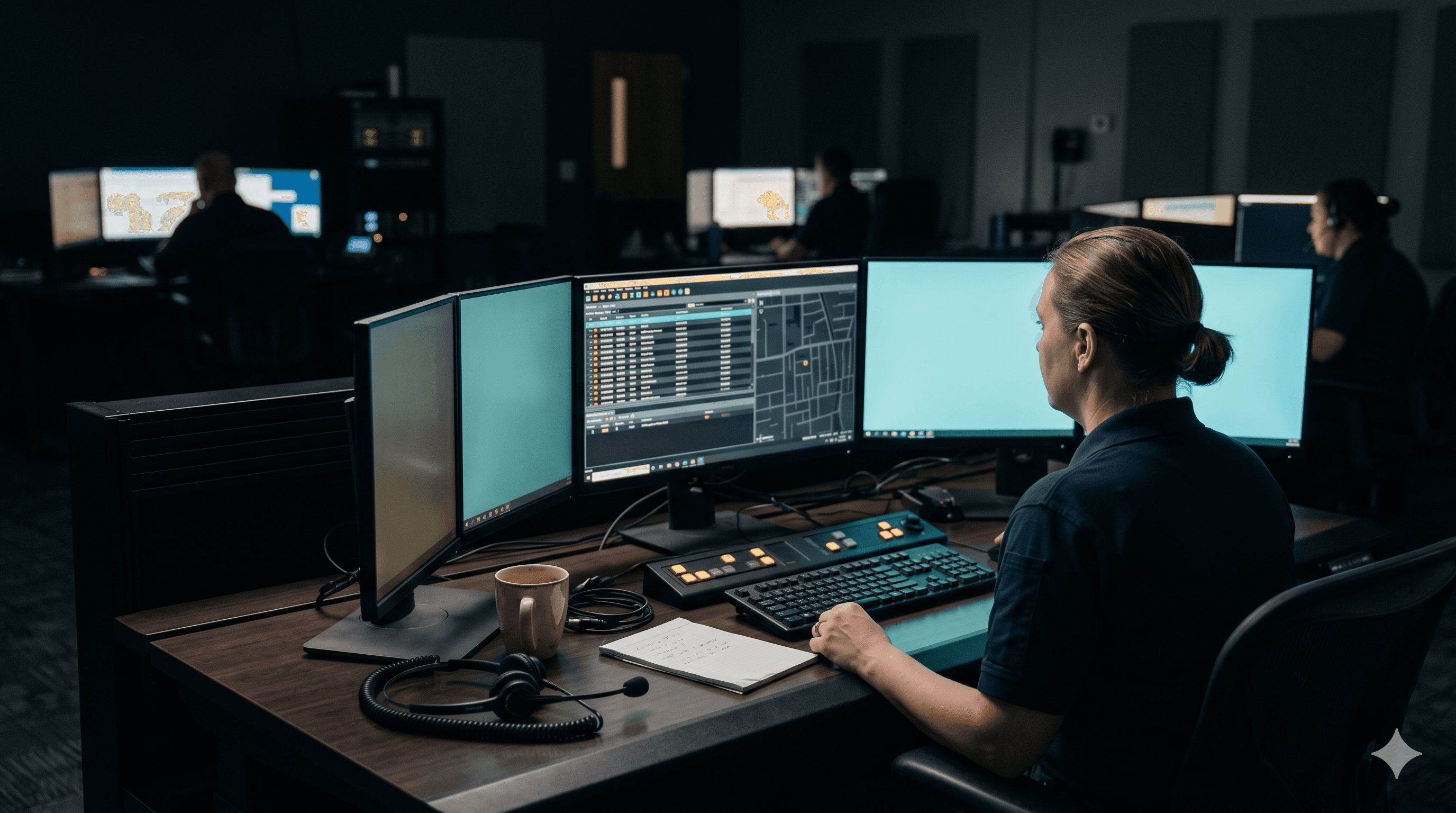
Your sensor trips at 2:14 a.m. The monitoring center calls 911. From the dispatcher's screen, your alarm is one of dozens of pending events that night, and somewhere between 94 and 99 percent of residential burglar alarms turn out to be false. That single number has reshaped how American police agencies handle alarm calls for the past 25 years. This post is the police-side view: how dispatchers prioritize the call, why cities like Salt Lake City rewrote the rules in 2000, what verified response actually means, and what changes the moment audio or video evidence is on the table. For the homeowner-side timeline, see what happens when your home security alarm goes off.
The False-Alarm Problem That Reshaped Policing
The U.S. Department of Justice's COPS Office laid out the core data in its problem-oriented guide False Burglar Alarms: alarm calls account for 10 to 25 percent of total calls for service in many cities, and the overwhelming majority are false. Phoenix PD, for example, responded to 48,256 alarm calls in 2018-2019, of which only 986 were legitimate, a roughly 98 percent false-alarm rate. Seattle averaged 25,000 alarm calls a year before its policy change, with 97 percent false. The LAPD has long handled north of 100,000 alarm calls annually with similar ratios. Every false call ties up an officer who could be at a real in-progress crime.
How Dispatchers Triage an Alarm Call
Most modern computer-aided dispatch (CAD) systems stamp every event with a priority level, typically Priority 1 through 4 or 5. A residential burglar alarm with no other information almost never gets Priority 1. It is usually treated as Priority 3 or Priority 4, meaning an officer rolls when one frees up, often without lights and sirens. Shots-fired calls, domestic violence in progress, and injury crashes all jump ahead.
What pushes an alarm up the queue:
- Audio verification — the monitoring center hears glass break, voices, or movement inside.
- Video verification — a camera operator confirms an unknown person on the property.
- Cross-zoning — a second sensor in a different zone trips, suggesting actual movement through the house.
- Panic or duress — almost universally handled as a Priority 1 in-progress crime.
- Enhanced Call Verification (ECV) — the monitoring center has already called two numbers and gotten no answer or an unverified response.
The International Association of Chiefs of Police formally endorses ECV, recommending alarm companies attempt at least two calls to two different numbers before requesting police dispatch. That single procedural step alone has cut needless dispatches by double-digit percentages in cities that adopted it.
Salt Lake City, 2000: The Verified-Response Earthquake
On December 1, 2000, Salt Lake City became the first major U.S. city to stop responding to unverified residential burglar alarms. SLC officers were finding that roughly 99 percent of the calls were false, according to the department's submission to the COPS Office. Under the new ordinance, the alarm company had to provide independent verification — eyewitness, audio, video, or a private guard on scene — before SLCPD would dispatch.
The numbers afterward were striking. Salt Lake City's police response to burglar alarms dropped roughly 95 percent, from about 10,500 dispatches per year to 500. The department effectively gained the equivalent of five full-time officers, decreased call-taker workload, and improved response times to other calls for service. There was no documented spike in completed burglaries, which was the principal counter-argument from the alarm industry at the time.
Who Followed (and Who Walked It Back)
Salt Lake City was the model, but adoption has been slower than headlines suggest. According to the Security Industry Association, only 19 of roughly 18,000 U.S. law enforcement agencies have adopted verified response in the 24 years since. Eleven other agencies tried it and reversed course, including South Salt Lake City, Dallas, Madison, San Jose, and Henderson. The most recent major adopter is Seattle, which switched to verified response on October 1, 2024, after years of escalating alarm volume.
The Middle Path: Permit-and-Fine Ordinances
Most American cities never went all the way to verified response. Instead, they adopted some version of the SIAC/IACP Model Alarm Ordinance, which keeps police responding while shifting cost and accountability onto chronic offenders. The framework typically requires three things: a permit on file, escalating fines after a small number of free responses, and a "no-response" status for households or businesses that exceed a fault threshold. For the broader picture of where break-in attempts are coming from and what is changing year-over-year, see our analysis of home security and break-in patterns in 2025, plus our explanation of why burglar alarms do not have timers.
Houston: A Real Fine Schedule
Houston runs one of the larger and better-documented programs in the country. According to the City of Houston Burglar Alarm Administration, the residential schedule looks like this:
- First three false burglar alarms in a 12-month period: free.
- Fourth and fifth false alarms: $50 each.
- Sixth and seventh: $75 each.
- Eighth and beyond: $100 each, with the permit subject to revocation and a no-response designation.
- Operating an unpermitted residential alarm: $116.75 per false-alarm incident.
- Panic/holdup false alarms escalate much faster, reaching $560.39 per event after the fifth.
Houston's structure is typical of the IACP-aligned approach: tolerable for normal homeowners, financially painful for chronic faulty systems, and procedurally simple for dispatchers, who keep dispatching by default.
What Verification Actually Changes
From the police side, verification is the variable that flips an alarm from a low-priority paperwork call into an in-progress crime. SIAC-funded research and the COPS Office both note that audio- or video-verified alarms are dispatched at higher priority, treated as a likely 459/burglary-in-progress, and frequently produce on-scene apprehensions because officers arrive while the suspect is still inside or fleeing.
That distinction matters when you choose a system. A bare contact-sensor alarm with no cameras is exactly the kind of signal a busy CAD queue de-prioritizes. A monitored system with verified audio or video, plus ECV, is the one that gets a faster ride. We covered the trade-offs in self-monitored vs. professionally monitored home security and the question of why these systems behave the way they do in why burglar alarms don't have timers.
Where Things Are Heading in 2026
Expect three trends to keep accelerating. First, more mid-size cities will follow Seattle into some form of verified response, especially in the West and Pacific Northwest. Second, monitoring centers will continue moving toward AI-assisted video review so a human operator can confirm or dismiss alarms in seconds rather than minutes. Third, insurers and police are starting to align around verified systems for premium discounts. We laid out the broader picture in home security technology trends for 2026.
The Bottom Line for Homeowners
Police are not ignoring your alarm — they are triaging it. With a 94-99 percent false-alarm rate baked into the data, dispatchers have to assume an unverified residential signal is probably not a real burglary, and they prioritize accordingly. The fastest, most aggressive police response goes to alarms that arrive with evidence attached: audio, video, cross-zoned sensors, or a panic signal. If you live in a verified-response city, that evidence is not optional — it is the only thing that gets a cruiser dispatched at all.
If you want a system designed for how police actually respond in 2026 — verified, video-enabled, professionally monitored, and built to clear the dispatcher's priority bar — start with our recommended setup at Smart Security Concierge, or read our pick of the best monitored home security systems.