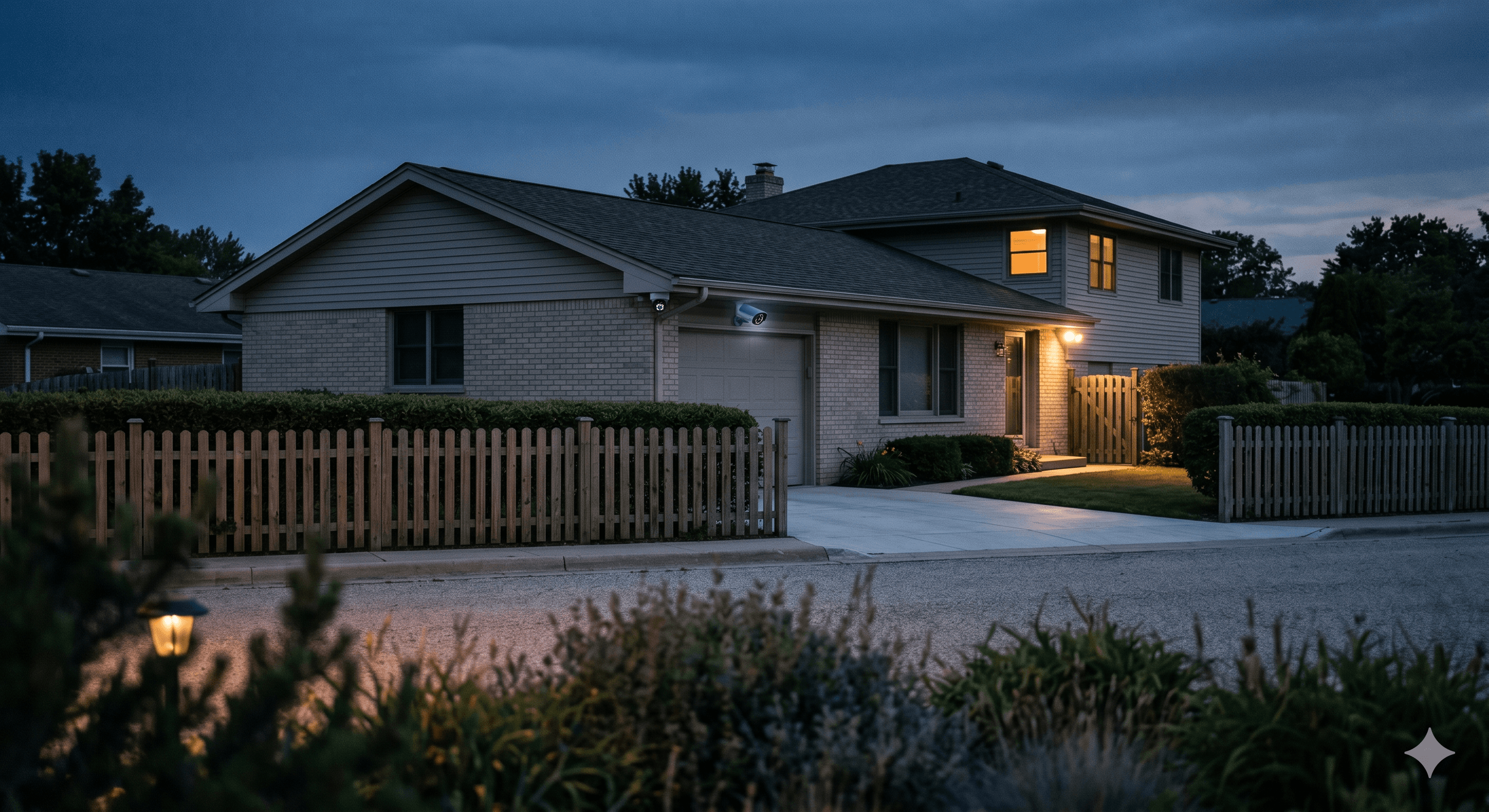
It is 0237 hours. A glass-break sensor on the rear sliding door trips. Your phone chimes. The dog is already up. You have not yet rolled out of bed, but your camera NVR has already started a 30-second clip, your driveway alarm logged a vehicle four minutes ago, and the deadbolt on the bedroom door is engaged because you set it that way every night. The intruder, who scouted your house in daylight, is now standing in the fatal funnel of your back patio realizing two things at once: the floodlight he did not see is on him, and the alarm he assumed was fake is screaming at 105 dB.
None of that happened by accident. It happened because somebody, at some point, sat down and built echelons of defense — concentric layers, each one buying time-to-target, each one giving the homeowner more of the OODA loop and the intruder less of it. That is the entire game. This post is the foundation of a five-part series on how serious people build serious home defense. Read it once, then read it again with a notepad.
In this article
- Echelons of Defense: How to Layer Home Security Like You Mean It
- Build the threat model first, not the gear list
- Layer 1: Deter — make your house the wrong target
- Layer 2: Detect — early warning at the property line, not the front door
- Layer 3: Delay — turn minutes into your friend
- Layer 4: Defend — the hard room and what happens when contact is made
- PACE the power and the comms — or none of it works
- What most consumer systems get wrong
- The bottom line
Build the threat model first, not the gear list
Most homeowners shop backwards. They buy a doorbell camera, a couple of stick-on contact sensors, and a yard sign, then call it a system. That is not a system. That is a starter kit with a marketing budget. Before you spend a dollar, write down what you are actually defending against. The threat menu for a normal American household, in rough order of likelihood:
- Opportunistic burglary — the dominant threat. UNC Charlotte's study of 422 convicted burglars found that 41% acted on impulse and only 12% planned in advance. They want easy, unoccupied, and quick.
- Package theft and vehicle prowls — high-volume, low-stakes, but they tell you who is scouting your block.
- Targeted home invasion — rarer but the consequence is severe. Occupants are home and assaulted.
- Disaster / WROL / grid-down — the long-tail scenario. Your system needs to keep working when the cloud, the cell network, or the grid does not.
The 2024 FBI UCR data shows burglary is down sharply from its 2005 peak — about 229.2 incidents per 100,000 residents, per the FBI Crime Data Explorer. Good news, but irrelevant to you the night your number comes up. Your job is to be the wrong house on the worst night.
Two doctrines drive the rest of this post. The civilian framework most often cited is Buckeye Firearms' four layers of home defense. The prepper community version is the five-layer concentric model laid out in SurvivalBlog's home perimeter defense write-up: Community, Neighborhood, Property, House, Room. Both say the same thing in different vocabulary — defense in depth, layered, redundant, each layer increasing the attacker's time-to-target so you can observe, orient, decide, and act. We will use the four Ds — Deter, Detect, Delay, Defend — and map specific gear to each.
Layer 1: Deter — make your house the wrong target
Deterrence is the cheapest layer per dollar of risk reduction, and the one most consumer systems botch by treating it as an afterthought. The UNC Charlotte study is unambiguous: 60% of burglars said an alarm presence would cause them to seek another target, and roughly half who discovered an alarm mid-attempt aborted the job. Visible deterrence is the layer that decides whether you are even in the candidate pool.
What deterrence actually looks like
- Exterior lighting on every avenue of approach. Not "porch light." Photocell-controlled or motion-triggered floods on the driveway, side yards, and rear patio. Eliminate dead space behind the AC unit and the shed.
- Visible cameras at the eaves, not in the doorbell. A turret or bullet camera on a soffit at 9–10 feet says "this property is hardened." A peel-and-stick doorbell does not.
- Yard signs and window decals from a real monitored alarm. They work — we covered the data on whether yard signs deter burglars. The short version: yes, but only if the system behind the sign is real.
- Maintained landscaping. Shrubs trimmed below window height, no concealment within 10 feet of any opening. A messy property reads as inattentive, and inattentive reads as a target.
- Gray man OPSEC. No "this house is protected by Smith & Wesson" doormat, no political flags screaming about what is inside, no Amazon boxes piled on the curb advertising your last purchase. The goal is to be uninteresting.
Choose cameras that are NDAA-compliant. After the FCC's November 2022 ruling implementing Section 889 of the 2019 NDAA, equipment from Hikvision, Dahua, Hytera, Huawei, and ZTE — and their dozens of OEM rebrands — cannot be authorized for sale into US critical infrastructure. The civilian market still floods Amazon with rebranded Hikvision and Dahua boards. If you do not know whose firmware is on your camera, you do not know whose servers it is calling home to. Stick with Axis, Hanwha, Avigilon, Verkada, Eufy's NDAA SKUs, Reolink's NDAA-listed PoE line, or comparable.
Layer 2: Detect — early warning at the property line, not the front door
If your first notification of an intruder is the contact sensor on your back slider chirping, you have already lost most of your time-to-target. Detection should start at the curb and work inward. This is the layer where preppers and serious self-defenders separate from the broader market.
Outer ring: driveway and approach
- Driveway alarms. Dakota Alert MURS-based sensors (the 2000-series, MAT, BBA series) push alerts on a licensed-by-rule MURS frequency at ranges that walk past most consumer Wi-Fi sensors. Guardline's wired-or-wireless PIR systems work for shorter driveways. These are not optional for rural or large-lot properties — they are how you get 60–120 seconds of warning before the headlights are in your window.
- Perimeter PoE cameras with analytics. Line-cross and intrusion-zone analytics on a local NVR (BlueIris, Synology Surveillance Station, Unifi Protect, Reolink NVR) give you a chime when somebody crosses your property line, not when they ring your doorbell.
- A dog. Not a tactical recommendation, an honest one. Dogs detect what your sensors miss and add a deterrent layer before any silicon is involved.
Inner ring: openings and interior
- Contact sensors on every exterior opening. Doors, ground-floor windows, garage pedestrian door, basement bulkhead. Two is one, one is none — pair contacts with glass-break for the openings you actually care about.
- Interior PIR motion in choke points. Hallways, stair landings. Set them to chime, not just to alarm, when you are home.
- Audible chime on every entry. A simple door chime is a force multiplier — it trains everyone in the house to turn their head when an opening cycles.
The bigger question is what happens when the sensor trips. We walk through the full sequence in what happens when your home security alarm goes off and what to expect from police response to a home alarm. Spoiler: the average dispatch-to-arrival time for an alarm-triggered call runs 10–15 minutes in suburban jurisdictions, longer in cities with non-response or verified-response policies, and longer still rural. Your detection layer is what gives you the head start to either lock down or get out before that clock matters.
Layer 3: Delay — turn minutes into your friend
Delay is target hardening. Every second the intruder spends on your structure is a second on your OODA loop and against his. The UNC Charlotte data again: most burglars spend less than 60 seconds attempting entry before moving on. Make 60 seconds a long way from getting in.
Doors
- Solid-core or steel exterior doors only. Hollow-core interior-grade doors on an exterior frame are the single most common failure point.
- Reinforced strike plates with 3-inch screws into the stud — not the half-inch screws that came in the box. Door Armor, StrikeMaster II Pro, or a comparable kit on every exterior door.
- Grade 1 or Grade 2 deadbolts. Skip the cylinder-only smart locks; pick smart locks that retain a real ANSI-rated deadbolt and a physical key. We covered selection criteria in the complete guide to smart locks for the front door.
- Hinge-side reinforcement. Hinge bolts and 3-inch hinge screws. Most kick-ins fail at the strike, but a determined attacker will go for the hinge side next.
Windows and glass
- 3M or Llumar security film on ground-floor and accessible second-floor glass. 8-mil minimum, 12-mil for the openings you really care about. It does not stop the glass from breaking; it stops the glass from clearing the frame so the attacker can climb through. You buy 30–90 seconds of additional delay per window for $8–$15 per square foot installed.
- Window security pins or aftermarket sash locks on double-hungs and sliders. A broomstick in the slider track is the prepper classic for a reason.
- Glass-break acoustic sensors covering each room with vulnerable glass — not just one in the living room.
Garage and outbuildings
- Disconnect the garage door opener emergency release from outside-coathanger reach — or zip-tie it with a shear-rated tie that requires deliberate force.
- Treat the pedestrian door from garage to house as an exterior door. Because it is.
Layer 4: Defend — the hard room and what happens when contact is made
If a determined attacker has cleared the first three layers, you are now in the worst case. This is where doctrine matters more than gear. The AOJ test taught by Massad Ayoob — Ability, Opportunity, Jeopardy — is the legal and tactical filter for use of force. Your house ROE should be written down, talked through with everyone in it, and rehearsed.
The hard room
- One designated fallback position per floor — usually the master bedroom upstairs, a designated rally point for kids if they need to move to you. Solid-core door, reinforced strike plate, deadbolt that can be engaged from inside.
- Comms inside the hard room. Cell phone on charger, plus a hardwired line or a cell-backup base station. PACE the comms: Primary (cell), Alternate (Wi-Fi calling on a separate carrier), Contingency (landline or cellular alarm panel two-way voice), Emergency (signal mirror, neighbor agreement, ham/GMRS).
- Light, identification capability, and a defensive tool appropriate to your jurisdiction and training. Positive ID before any decision — the bedroom door opening at 0300 is statistically more likely to be a teenager than an intruder, and you are responsible for every round you fire.
- A camera view of the hallway outside the hard room, on a tablet or phone, so you can see what is coming without opening the fatal funnel of your own door.
The plan, written down
Run it like a fire drill. Where do the kids go? Who calls 911? Who stays at the hard room door? What is the verbal challenge that tells responding officers you are the homeowner? What is the rally point if the house is on fire and the threat is still inside? Buckeye Firearms is right that the plan is itself a layer.
PACE the power and the comms — or none of it works
Two is one, one is none. Every layer above assumes the system stays up. Most consumer systems do not.
- Power: Primary grid; Alternate a UPS on the NVR, router, and alarm panel sized for at least 4 hours; Contingency a generator (inverter or standby); Emergency battery-backed cellular alarm radio that runs 24+ hours on its own cell.
- Comms: Primary home internet; Alternate cellular failover on the alarm panel (LTE-M is now the floor — 3G sunset is done); Contingency a second carrier hotspot; Emergency GMRS or ham for neighbor mesh and out-of-band signaling.
- Recording: local first. A PoE NVR with on-device storage that keeps recording when the WAN goes down, with optional cloud as a secondary. Anything that requires the cloud to record is one ISP outage away from being a paperweight.
If you are weighing whether to pay a monitoring company for any of this, our breakdown of self-monitored vs. professionally monitored systems covers the tradeoffs honestly. Short version: pro monitoring buys you a dispatcher at 0300; self-monitoring buys you control and zero recurring fees but assumes you will hear the alert.
What most consumer systems get wrong
If you have made it this far, you already know what is coming. Most off-the-shelf "smart home security" kits fail the doctrine in predictable ways:
- Forced cloud recording. No cloud account, no footage. ISP outage, no footage. Vendor goes bankrupt, no footage. This is unacceptable for a defensive system.
- No PoE option. Wireless cameras have a place — renters, second story, temporary — but the trunk of your camera system should be PoE wired. Batteries die at the worst possible moment, which is the entire premise of an attack.
- Chinese-made cameras with opaque firmware. Hikvision, Dahua, and the OEMs that rebrand them. Even with the FCC ban, they are still everywhere on retail shelves under unfamiliar names. IPVM maintains a public NDAA guide if you want to verify a SKU.
- No cellular or battery backup on the panel. A cut phone line or a tripped breaker should not take the system off the air. A real alarm panel has a sealed lead-acid or lithium battery good for 24 hours and a cellular radio that does not depend on your Wi-Fi.
- Subscription lock-in. If you stop paying, the cameras stop working. We rate vendors on this in the best home security systems to buy in 2026 and the broader best monitored home security system rundown.
- One-radio, one-protocol design. Z-Wave only, or Wi-Fi only. Real layered systems mix wired contacts, encrypted RF (319.5 MHz, 345 MHz, S-Line), Z-Wave for locks, and Ethernet for the backbone. Two is one.
If you are renting and think none of this applies to you, it does — we wrote a separate playbook for layered security in a rental that respects your lease and still gets you four real layers. And if you want to verify how all this behaves from your phone before you buy, walk through remote control of a home security system first.
The bottom line
Layered home defense is not a product you buy. It is a doctrine you implement, and then a system you maintain. Deter at the property line. Detect at the curb and the openings. Delay at the structure. Defend from the hard room. Back every layer with PACE redundancy on power and comms. Stay NDAA-compliant. Record locally. Practice the plan. Two is one.
If you want to spec a system that actually meets these layers — PoE backbone, NDAA-compliant cameras, local-only recording with optional cloud, cellular and battery backup on the panel, no forced subscription, smart locks that keep a real deadbolt — we will sit down and work through it with you. No sales pitch, no upsell scripts, no commissioned reps reading from a flowchart. Spec it out with us at smartsecurityconcierge.com/order-confirmation and we will tell you honestly what fits your threat model and your house.