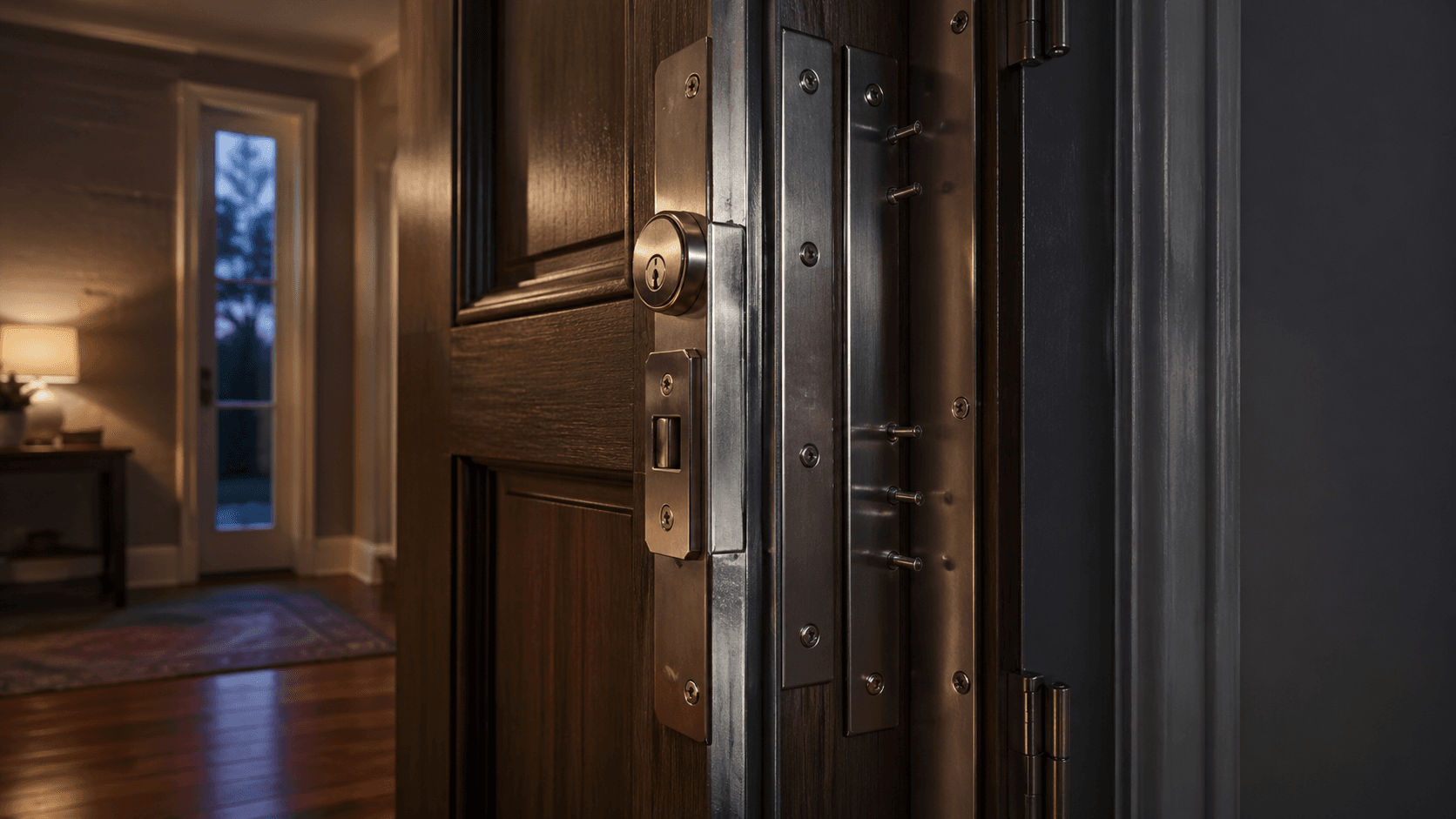
Most home-defense content fixates on cameras, alarms, and what's in your nightstand. Those matter — they're the detect and respond echelons. But the cheapest, most overlooked layer in defense in depth is the one that buys you the seconds you need to use any of the rest of it. The delay echelon: physical hardening of the doors, windows, and frames that form your home's actual envelope. Every additional second an intruder spends fighting your front door is a second added to your time-to-target budget — a second to wake up, get oriented, get to a phone, get to a hard room, get to a firearm. Delay is the force multiplier the rest of your stack relies on.
And almost nobody does it. A 2013 University of North Carolina at Charlotte study of 422 incarcerated burglars (lead investigator Joseph Kuhns) found that ease of entry was a top selection criterion across the board, that 83% of burglars said they checked for alarms before entering, and that 60% would pick a different target when an alarm was detected (UNC Charlotte burglar study). The same study found most burglars used the lowest-effort path possible: open windows, force a door or window. Only about one in eight attempted lock-picking. The implication is brutal and useful: harden the obvious avenues of approach and most criminal opportunists move on. This guide is the gear-heavy, spec-heavy walkthrough.
For the wider strategy that this fits inside, see the echelons of defense framework. Delay is one layer. It's the one most people skip.
In this article
- Door and Window Hardening: The 'Delay' Echelon Done Right
- Why Doors Fail: The Four Failure Points
- The Garage-Entry Door: The Soft Flank Most People Forget
- Sliding Glass Doors and French Doors: The Soft Underbelly
- Windows: The Second-Most-Common Entry Point
- High-Security Cylinders: When You Need Pick and Bump Resistance
- Smart Lock Integration With the Rest of the Stack
- The Economics of Hardening
- Spec Checklist (Priority Order)
- Getting the Detection Layer Right
Why Doors Fail: The Four Failure Points
The average suburban exterior door is a kick away from defeat. Not because the door itself is weak — most modern entry doors are solid-core wood, fiberglass, or steel-skinned and quite stout — but because the frame around the door is held to the studs with a handful of 3/4" finish nails and the strike plate is fastened with two stamped 3/4" trim screws into pine jamb wood. A 200-pound man putting his foot through the door near the lock is delivering several thousand pounds of impact force. The lock holds. The screws shear. The trim splinters. The door swings open. Most home invasions of "secured" homes are this exact failure mode.
To harden a door properly you have to fix four discrete failure points: the door slab itself, the strike plate, the deadbolt, and the hinges. Skip any one and you've spent money on the others for nothing — the chain breaks at the weakest link. Greg Ellifritz and Massad Ayoob both make the same point in different language: a door's resistance is the resistance of its weakest component, full stop.
1. The Door Slab
If your front, back, or garage-entry door is hollow-core (you can hear the hollow when you knock — and yes, builders absolutely use hollow-core on garage-to-house doors), replace it. A hollow-core door defeats a determined kick in under a second. Specify a 1-3/4" exterior-grade slab in one of three constructions:
- Solid-core wood — heavy, classic, refinishable. Look for stile-and-rail with engineered or solid-lumber core.
- Steel-skinned with insulating core — the workhorse. 24-gauge or heavier skins on a polyurethane or wood-edged core. Affordable, consistent, very hard to defeat without a pry bar and time.
- Fiberglass composite — won't dent like steel, won't rot like wood. Therma-Tru and similar. Good for coastal climates.
Whatever you choose, look for a door rated for exterior use and certified to the relevant ANSI/BHMA standard. The Builders Hardware Manufacturers Association (BHMA grade levels) defines progressive performance benchmarks — Grade 1 highest, Grade 3 lowest — covering security, durability, and finish.
2. The Strike Plate — Highest-ROI Hardening You Can Do
This is the single most important upgrade in this entire post. Stock strike plates ship with two stamped screws roughly 3/4" long. Those screws bite trim wood, not framing. Pull them out and look at the raw hole; nine times out of ten, the bolt of your $80 deadbolt is being held in place by less than an inch of pine.
The fix is cheap and takes twenty minutes:
- Replace the stock strike with a heavy-duty box strike — Defender Security and similar reinforced strike plates run roughly $10-25, with four to six screw holes and a wraparound box that captures the bolt on three sides instead of one.
- Fasten with 3" deck screws or construction screws (#9 or #10 gauge) so they pass through the jamb and bury at least 1-1/2" into the king and trimmer studs behind the jamb. This is the load-bearing framing — what holds your house up. It does not move.
- For full-frame protection, install a Door Devil or equivalent door-frame reinforcement kit. Door Devil's flagship is a 48" steel plate that runs the length of the latch-side jamb with multiple 3-1/2" structural screws — turning the entire jamb into a single steel-and-stud composite. Run about $80-130 per door. There are competing kits (StrikeMaster II, Armor Concepts) — verify the kit you buy specifies 16-gauge or thicker steel and includes 3" minimum screws.
This single upgrade transforms a one-kick door into a multi-minute battering project. Most opportunist intruders abandon at the first failed kick.
3. The Deadbolt
Specify BHMA Grade 1. Schlage confirms on their grades and functions page that all of their mechanical deadbolts (B-series and current production) and their Connect / Sense / Touch smart locks are certified AAA — the highest rating across BHMA's three categories: security (resistance to sledgehammer impact, pulling, and weight), durability (cycle counts and temperature extremes), and finish.
- Schlage B60N — long-running residential Grade 1 deadbolt. Hardened steel bolt, anti-pick anti-drill features, AAA rated. Often cited as the bare minimum on r/homedefense and similar communities.
- Kwikset 980 series — Grade 1, with the SmartKey rekey feature on certain SKUs.
- Medeco Maxum — Grade 1 deadbolt with high-security cylinder built in (covered below).
Two is one, one is none. Where the geometry of the door and frame allow, run two deadbolts — one at standard height, one near the bottom. The auxiliary doesn't have to be Grade 1. It just has to be one more thing the intruder has to defeat. Even a $25 surface-mount slide bolt or a Door Guardian-style kick-down adds 30 seconds and a second point of attack. That's enough.
Modern smart locks now reach Grade 1 too — Schlage Encode Plus, Yale Assure SL, Level Bolt — without giving up tamper alerts, failed-attempt logging, or remote lock/unlock. Smart locks aren't softer than mechanical when you spec correctly. See the complete guide to smart locks for the front door for the deep dive.
4. The Hinges
Most homeowners think of doors as defeated lock-side. Half the time they're defeated hinge-side — the door pops at the hinges first because hinge screws are the same 3/4" trim garbage as the strike. Fix:
- Replace at least one screw per hinge leaf — and ideally two — with 3" structural screws that bite into the studs.
- For exterior doors with exposed hinge pins (pins on the outside), either replace with security hinges (non-removable pin, set screw, or stud-and-hole geometry) or install hinge-side reinforcement plates — the lateral cousin to the Door Devil.
- Three hinges minimum on any exterior door. Four on heavy slabs.
The Garage-Entry Door: The Soft Flank Most People Forget
Your house-to-garage door is, in 80% of homes built in the last forty years, the worst door on the property. It's hollow-core. It has the cheapest possible strike. The deadbolt — if there even is one — is builder-grade. And the garage door itself is often left unlocked, with a remote sitting in a car parked in a driveway. That's not a door, that's a posted invitation.
Treat the garage-entry door as fully exterior. Same spec as the front: solid-core or steel slab, BHMA Grade 1 deadbolt, reinforced strike, hinge-side screws. For the deeper treatment of the entire garage as a security flank — including the overhead door, the wall-mount opener, and the remote-in-car problem — see the garage as a soft flank.
Sliding Glass Doors and French Doors: The Soft Underbelly
FBI Uniform Crime Reporting data and most state burglary studies consistently show first-floor windows and rear sliding doors as a significant share of forcible entries — second only to front doors in many datasets. The reason: most slider stock latches are a curl of stamped metal, and most French doors hide their failure point inside the inactive panel.
Sliding Glass Doors
- Wooden dowel or steel bar in the track — free or near-free. Cut a 1x2 or buy a flat steel security bar. Drops into the inside track. The door cannot slide open. This is the easiest no-tools security upgrade in the entire house.
- Pin lock through the frame — drill a 1/4" hole through the inside fixed frame into the moving frame at a closed position; insert a hardened pin. About $10. Prevents both sliding and lift-and-out attacks.
- Foot-bolt at the bottom — surface-mount foot lock screws into the inside of the active panel and engages the track. Add at the top for lift prevention.
- Auxiliary slider locks (Door Stopper, Sliding Door Lock, similar surface-mount aux locks) — a second mechanical interrupt for $20-40.
The combination — bar in track plus pin lock plus glass-break detection — turns a slider from the easiest entry on the property into a noisy, slow defeat path. Glass-break sensors complement hardening (hardening delays, sensors detect). See glass break sensors as a home-defense layer.
French Doors
The active panel uses a deadbolt; the inactive panel relies on flush bolts at top and bottom that engage the head jamb and the floor (or threshold). Stock flush bolts engage trim, not framing. Fix:
- Heavy-duty deadbolt on the active panel — Grade 1, with the strike-plate treatment above.
- Surface-mount or mortised flush bolts on the inactive panel, engaging into steel strikes mortised into the header framing and floor, not jamb trim.
- Astragal reinforcement — the vertical strip between the two doors should be steel-reinforced or include a security astragal. Defeats pry attacks at the seam.
Pet Doors
A defeat path most people never think about. Burglars do. A 10x14 dog flap is enough for a small adult to crawl through, and at minimum it's an arm's reach to the deadbolt thumb-turn. Solutions:
- RFID or microchip-activated pet doors (SureFlap, PetSafe SmartDoor) — only opens for the chipped pet's collar. Not a hardened locked door, but a closed barrier most of the time.
- Manual lock at night — 4-way slide locks on most pet doors. Use them.
- Security door covers — heavy steel covers that lock over the pet flap when you're sleeping or away.
Windows: The Second-Most-Common Entry Point
The average burglary is over in under ten minutes — most criminals are working a tight time budget and any prolonged effort triggers withdrawal. Windows look fragile but a smashed window is loud, slow, and cuts the intruder. Hardening makes those problems worse for them.
Security Film
3M Safety & Security window films (the S-series, including S70 and S140 for clear interior bonding) laminate a tough polyester layer to the inside face of the glass. A baseball bat to a filmed window doesn't shatter — it spider-cracks but holds together, and an intruder has to repeatedly batter the frame to get through. Cited test footage shows 30+ seconds of sustained battering vs. one swing on bare glass.
- 3M Safety & Security S70 — 7-mil clear film, common DIY spec.
- 3M S140 — 14-mil, heavier, used in commercial / high-threat applications.
- DIY install ~$8-15/sqft material; pro install ~$20-30/sqft. Pro install with anchored edge attachment systems (frame-bonded "wet glaze") is significantly stronger than free-floating film.
Film alone is not bulletproof, not impenetrable, and not a substitute for a deadbolt. It's a delay multiplier on a soft surface. Combined with a glass-break sensor it becomes a very ugly entry path for an intruder — slow and audible.
Window Pin Locks
For double-hung and slider windows. Drill through the inner sash into the outer at a closed position, and a second hole at a 4-6" "ventilation" position. Insert a hardened pin. The window can be opened to vent but not enough to admit a person, and the pin cannot be defeated from outside without breaking glass. Cost: under $10 in pins.
Bars, Grilles, and Decorative Iron
Aesthetically polarizing, but for ground-floor windows in higher-threat neighborhoods, often the right call. Specify:
- Quick-release internal bars — fire-code compliance requires every bedroom egress window to be releasable from inside without a tool. Don't trap your family for the sake of hardening.
- Decorative wrought-iron storm doors / security screen doors — Titan, First Impression, Andersen. Adds a second locked door to the front entrance with full visibility. The interior door can stay open in summer; the iron screen stays locked.
High-Security Cylinders: When You Need Pick and Bump Resistance
Most homeowners don't get attacked through the keyway. The UNC Charlotte data confirms only about one in eight burglars try to pick. But if you're in a higher-risk profession, have publicly known valuables, or simply have read enough on r/lockpicking to know how trivial standard residential cylinders are, you want a cylinder rated to UL 437 (Underwriters Laboratories' standard for resistance to surreptitious entry by picking, drilling, prying, and key duplication) and/or ANSI/BHMA A156.30 for high-security cylinders. Brands:
- Medeco — angled-pin design plus rotating side-bar. Very pick-resistant. Restricted keyways.
- Mul-T-Lock — interactive pin-in-pin, dimple keys. Heavy-duty restricted keys.
- ASSA Abloy (and the Abloy Protec line) — disc-detainer mechanism, near-impossible to pick by hand.
- BiLock — twin-blade key, U-shaped sidebars, restricted distribution.
The cost premium is real ($150-300+ per cylinder vs. $30 for a builder-grade). For most homeowners, Grade 1 deadbolts plus reinforced strikes plus film and sensors is enough. For some readers, this is the right next step.
Smart Lock Integration With the Rest of the Stack
Modern smart locks aren't security-vs.-convenience tradeoffs. Done right, they're force multipliers: they tell you when someone is trying codes, lock automatically when you leave (geofence), and accept temporary codes for service workers without exposing a physical key under a rock. Specify locks that:
- Hit BHMA Grade 1 (Schlage Encode Plus, Level Bolt, Yale Assure SL) — same physical resistance as a mechanical Grade 1.
- Support local logging and tamper alerts that feed your security panel.
- Are NDAA-compliant and don't force cloud-only operation. Local control is a non-negotiable for self-reliant readers.
For the full breakdown including specific models, see the complete guide to smart locks for the front door. Pair the lock with motion sensors and door chimes for layered detection: motion sensors as early warning and door chimes inside the OODA loop.
The Economics of Hardening
Done DIY, the entire physical envelope of a typical 4-bedroom home can be hardened for under $1,000:
- Front door: Door Devil + Grade 1 deadbolt + hinge screws + heavy strike — ~$200
- Back door: same package — ~$200
- Garage-entry door: solid-core swap + hardware — ~$250
- Sliding glass door: bar + pin + aux lock — ~$50
- Security film on six accessible windows (DIY S70) — ~$300
Compare to the cost of an actual burglary: average reported losses run $2,500-5,000 in stolen property alone, but real-world cleanup including damage to doors and frames, replacement of irreplaceable items (firearms, family photos, identity documents), insurance deductible, time off work, and the lasting psychological cost on a family routinely runs $10,000-30,000+. The hardening package pays for itself in the first attempted entry it deflects — and the UNC Charlotte data says it deflects most of them.
For renters who can't drill into framing or replace doors, see security systems for renters and lean harder on detection and aux locks (door bars, portable jammers, slider bars). For the broader system comparison, home security system comparison. And don't forget the cheap deterrent multiplier — alarm yard signs tested in the same UNC Charlotte study as a real factor in target selection.
Spec Checklist (Priority Order)
If you do nothing else this weekend, do this list — top down. The first three items will catch 90% of the value.
- Replace strike plate screws on every exterior door with 3" structural screws into framing. Free if you have screws on hand. Twenty minutes per door.
- Install a heavy-duty strike plate or full-frame reinforcement kit (Defender Security, Door Devil, StrikeMaster II) on every exterior door.
- Replace any non-Grade-1 deadbolt with a BHMA Grade 1 (Schlage B60N, Kwikset 980, or smart-lock equivalent like Schlage Encode Plus).
- Replace one screw per hinge leaf with 3" structural screws.
- Replace hollow-core garage-entry door with solid-core or steel-skinned exterior-grade slab.
- Install track bar + pin lock on sliding glass doors.
- Install flush-bolt-into-framing upgrade on French doors.
- Apply 3M Safety & Security S70 film to all ground-floor accessible windows and rear sliders.
- Install window pin locks on double-hung windows in ventilation positions.
- Add glass-break sensors in rooms with large windows or sliders.
- Upgrade to high-security cylinders (Medeco, Mul-T-Lock, ASSA, BiLock) on critical doors if your threat profile justifies it.
- Pair hardening with detection: motion sensors, door chimes, glass-break sensors, monitored panel.
And finally — hardening is the foundation, not the whole structure. If a determined intruder gets through despite all of this, your fallback is the hard room as the final fallback position. Delay buys you the time to get there.
Getting the Detection Layer Right
Hardening alone is half the equation. The other half — the layer that turns "they're trying" into "you know they're trying, and so does your monitoring center" — is sensors, smart locks, chimes, and a panel that ties them together. We spec systems that complement physical hardening rather than competing with it: NDAA-compliant gear, local recording, no forced cloud, sensors and locks that talk to one panel. If you'd like a system speced to fit what you've already hardened (or are about to), tell us about your home and we'll put a build together. No pushy sales — your hardening, your detection, your call.