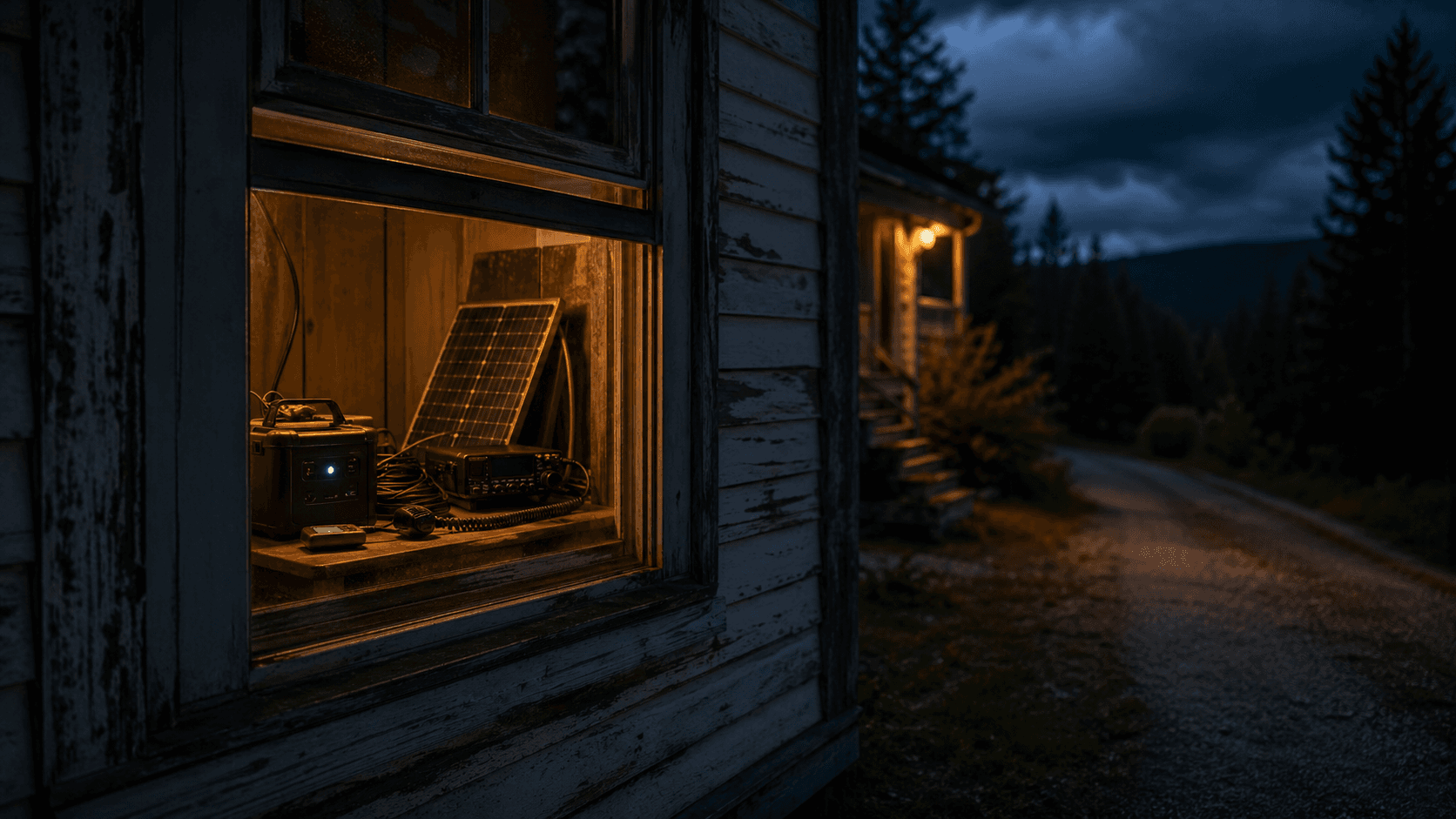
The night Hurricane Helene came ashore in September 2024, a homeowner in western North Carolina watched his alarm panel go from green to amber to dead inside of two hours. The fiber line dropped first when a tree took down a span up the road. The cellular backup on the panel held for about ninety minutes before the nearest tower lost generator fuel and went silent. By midnight he had no notifications, no remote camera view, no way to reach the monitoring center, and no way to call his brother three counties over. According to FCC reporting, Helene knocked 3,432 cell sites offline across five states — the worst storm-related cellular failure on record. In the worst-hit North Carolina counties, more than 74% of cell sites were down. His house still had locks. It still had a dog. It still had a shotgun in the safe. What it did not have was a single working comms path to the outside world.
That is the scenario this post is built around. If your home security system depends on one router, one ISP, and one cellular module — and most do — you have a single point of failure dressed up as a security system. The fix is not a better gadget. The fix is a doctrine: communications redundancy, organized as a PACE plan, with honest acknowledgment of where each tier breaks.
In this article
- Communications Redundancy: Keeping Home Security Online When the Grid Goes Dark
- Two Is One, One Is None: Why Comms Redundancy Is The Spine
- Primary: Wired Internet + AC Power (Normal Operating Mode)
- Alternate: Cellular + Battery Backup (24-72 Hour Window)
- The Cellular Paradox: Why Tier Two Often Fails Next
- Contingency: Local-Only Detection, Local Siren, Local Recording
- Emergency: Off-Grid Power, RF Comms, and Human Runners
- EMP and Carrington-Class Events
- What Fails First: An Honest Hierarchy
- Spec Checklist: A PACE-Compliant Home Security Stack
- Spec Out Your PACE Plan With Us
Two Is One, One Is None: Why Comms Redundancy Is The Spine
The military mantra two is one, one is none exists because every comms path has an avenue of failure. Cable internet fails when the pole goes down. Cellular fails when the tower congests or runs its battery dry. Cloud services fail when a third party two thousand miles away pushes a bad config — exactly what happened to AT&T on February 22, 2024, when an equipment configuration error knocked out 125 million devices and blocked 92 million calls — including more than 25,000 attempts to reach 911. Power fails when an ice storm or a transformer fire takes the grid down. Each of these has happened. Each will happen again.
The PACE plan — Primary, Alternate, Contingency, Emergency — is how Special Forces teams structure communications so that no single failure ends the mission. Applied to home security, it gives you four independent ways to detect, alert, and call for help, and a clear-eyed answer to the question: what protects my family when path one is gone?
Layer this on top of the physical defenses we cover in Echelons of Defense: Layered Home Security and you have a system that does not get silenced by a downed pole.
Primary: Wired Internet + AC Power (Normal Operating Mode)
This is how your system runs 95% of the time. Cable or fiber to the modem, AC power to the router, cameras streaming to NVR and to the cloud, the panel reporting opens/closes/alarms in real time. Push notifications fire to your phone in two seconds. The monitoring center sees signals.
This is the easy mode. It is also the mode the homeowner above lost in the first hour of the storm.
What "primary" should look like spec-wise
- NDAA-compliant cameras (no Hikvision, Dahua, or rebrands) — required for federally funded sites and a sensible baseline for serious owners.
- PoE-wired cameras to a local NVR, not WiFi-only. WiFi cameras die the moment the router does. PoE keeps recording on a single Ethernet drop powered from a UPS.
- Local recording on NVR or SD card with no forced cloud subscription. If the cloud goes, the footage stays.
- Hardwired sensors where possible. Wireless RF sensors are fine, but understand they have their own batteries and their own avenues of failure (covered in Motion Sensors as Early Warning).
Alternate: Cellular + Battery Backup (24-72 Hour Window)
When the ISP drops or the modem loses power, your alarm panel should fail over to a cellular module on its own internal battery. Every reputable monitored panel — ADT Command, Vivint Smart Hub, SimpliSafe, Ring Alarm Pro, Qolsys IQ4, Honeywell ProSeries — supports this. The UL standard governing residential alarm batteries (UL 1023, with installation per UL 985) generally requires 24 hours of standby on the panel battery before primary AC is restored, with the alarm still able to sound for 4-15 minutes after that. That is a floor, not a ceiling.
Gear that buys you time
- UPS on the modem and router — APC Back-UPS BX1500M (1500VA / 900W) or CyberPower CP1500AVRLCD. A modem and a small router pull about 25-40W combined; a 1500VA UPS will run them 4-8 hours unaided. Worth every dollar.
- UPS on the NVR — same logic. A four- or eight-channel PoE NVR plus four cameras is typically 40-70W. The same APC unit will keep them recording for hours.
- Cellular module in the panel — verify the carrier (AT&T LTE-M, Verizon CAT-M1, T-Mobile LTE) and the monthly cost. Many "cellular included" claims hide a $5-15/month line item. Worth it; just know what you are paying.
- Solar generator for medium-duration outages — Bluetti AC180 (1152Wh), EcoFlow Delta 2 (1024Wh), or Goal Zero Yeti 1500X (1516Wh). Pair with a 200W folding panel. A typical security stack (modem + router + NVR + four PoE cameras + panel) draws 80-120W; a 1000Wh battery runs it 8-12 hours, and with daylight solar input you can stretch that to days.
This tier is also where professional monitoring earns its keep. We make the full case in Best Monitored Home Security System and Self-Monitored vs Professionally Monitored — short version: a UL-listed central station with redundant data centers and cellular-backup signaling is another node in your PACE plan, not a replacement for it.
The Cellular Paradox: Why Tier Two Often Fails Next
Here is the part most homeowners get wrong. They assume cellular is the safety net. In a localized event — kid kicks the modem cable loose — sure, it is. In a regional event, cellular fails right after wired internet, not last. Three recent reminders:
- Hurricane Helene (Sept 2024) took 3,432 cell sites offline across five states. In hard-hit counties, three of every four towers were down for days.
- The AT&T nationwide outage of February 22, 2024 — not a storm, not a cyberattack, just a bad config push — put 125 million devices offline for up to 12 hours.
- The AT&T 3G sunset on February 22, 2022 bricked roughly 2 million security, fire, and medical alert devices that had not been upgraded. If your panel is more than five or six years old, verify it is not riding a sunsetted radio. Honeywell, DSC, and 2GIG all sold panels that became silent overnight.
The takeaway: cellular is necessary but not sufficient. You need a tier below it that does not depend on any external carrier at all.
Contingency: Local-Only Detection, Local Siren, Local Recording
This is the tier that separates serious home defenders from people with smart-home hobbies. When every external comm has failed, your system should still protect the family. Not by calling for help — that ship has sailed — but by detecting, alerting, and recording locally.
What still works when the cell tower is off the air
- Local siren on the panel. A 105 dB indoor siren and an exterior 120 dB strobe-siren combo function as standoff and area-denial. The intruder does not know the siren is local-only. He hears the screamer and assumes the cavalry is on the way. That is force-multiplier psychology — covered more in Tactical Exterior Lighting and Area Denial.
- NVR / SD recording. PoE cameras to a local NVR keep recording on UPS power for hours. Footage is still there when the lights come back on — useful for both prosecution and after-action review.
- Door chimes and audible motion alerts. A door chime tied to a contact sensor still beeps inside the house even if the cloud is gone. We dig into the OODA-loop value of that beep in Door Chimes and the OODA Loop.
- Dakota Alert MURS driveway alarm. This deserves its own paragraph.
Dakota Alert MURS: the gold standard for grid-independent early warning
The Dakota Alert MURS system uses Multi-Use Radio Service frequencies in the 151-154 MHz band. The probe sits at the end of your driveway. The receiver sits on a counter inside the house. When a vehicle (or person, on the PIR variants) trips the probe, the receiver beeps or speaks a pre-recorded zone announcement. No internet. No cellular. No router. No subscription. Range is up to a mile or two depending on terrain. The receiver runs on AC with battery backup; the probe runs on a 9V battery for a year. This is the closest thing in the consumer market to a grid-independent perimeter trip wire, and every prepper-minded household should have at least one.
Emergency: Off-Grid Power, RF Comms, and Human Runners
This is the WROL / SHTF tier. The grid has been down for days. Cellular is gone. Your generator's gas is finite. The question is: how do you keep detecting, and how do you talk to family or neighbors?
Off-grid power for the security stack
- LiFePO4 battery bank sized to 24-72 hour panel + camera load. EcoFlow Delta Pro (3600Wh) or two Bluetti AC180s in parallel will run a hardened security stack for two to four days unaided.
- 200-400W of solar input. Even cloudy-day yields of 30-50% of nameplate are enough to keep a 100W security load alive indefinitely.
- DC-only camera kit as a backup — 12V analog or IP cameras wired direct to a small DC power bank, bypassing AC entirely. Lower image quality, but bulletproof simplicity.
RF comms: GMRS and amateur radio
When cellular is gone, RF works. Two licenses cover the practical range:
- GMRS (General Mobile Radio Service) — $35 for a 10-year license, no test, covers your entire immediate family. UHF, 22 channels, up to 50W on mobile/base, repeater-capable. Excellent for family-to-family and neighborhood comms within 1-25 miles depending on terrain and antenna. Gear: Midland MXT500 or MXT575 mobile (50W), Wouxun KG-805G handheld.
- Amateur radio (ham) — Technician class is a 35-question exam, 10-year license. Covers VHF/UHF (2m/70cm) for local/regional and limited HF for longer reach. General class opens up worldwide HF. Gear: Yaesu FT-60R handheld, Icom IC-2730A mobile, and for HF an Icom IC-7300 base station.
- Baofeng UV-5R — the $25 dual-band handheld every prepper owns. Honest assessment: Tier-2 amateur quality, frequency stability is mediocre, the receiver is wide-open. Fine as a backup. Do not make it your only radio.
Pre-arrange family rally points and check-in windows. "If we lose all comms by Tuesday noon, meet at Aunt Linda's by Wednesday sundown." That is doctrine, not paranoia.
EMCON — controlling your RF signature
Advanced consideration: every transmission gives away that you are home, awake, and have working electronics. In a true WROL scenario, emissions control matters. Listen more than you transmit. Use low power when you do. Pre-share frequencies and call signs with your group so you do not have to broadcast plaintext call-out details.
EMP and Carrington-Class Events
Brief and honest: a high-altitude EMP or a severe geomagnetic storm (a Carrington-class coronal mass ejection) could take down regional or continental electronics. The Congressional EMP Commission's reports lay out the scenario in detail — vulnerability of the grid, expected recovery times, hardening recommendations. We are not going full doomer. We are saying: it is a non-zero risk, the federal government takes it seriously, and the mitigation is cheap.
Practical EMP-aware hardening
- Faraday bags or cans — Mission Darkness or EDEC Black Hole bags for a backup phone, a backup Baofeng, an external SSD with critical documents, and a spare router. A galvanized metal trash can lined with cardboard works for larger items if sealed properly.
- Hard-wired analog driveway alarm — older non-electronic perimeter trips are EMP-immune by definition.
- NVR with rotating local storage — keeps the last 30 days of footage on hardware you own. Pull the drive, store a backup in the Faraday can, swap quarterly.
You do not need a bunker. You need a $40 Faraday bag with a working radio in it.
What Fails First: An Honest Hierarchy
If you remember nothing else, remember this order:
- Grid power — varies wildly. Could be 15 minutes (lightning hits a transformer); could be 14 days (Helene in the mountains).
- ISP / wired internet — typically dies within 15 minutes of grid loss unless your modem is on UPS. Even with UPS, fiber/cable infrastructure upstream eventually fails.
- Cellular — towers have battery backup (typically 4-8 hours) and many have generators (24-72 hours of fuel). In a regional event, cellular is gone within a day or two. In a software event (see Feb 2024 AT&T), cellular can be gone in 12 hours nationwide.
- Cloud services — independent of your local power. AWS, Google, or your security vendor's cloud can drop while your house has full power. Your panel pings home and gets nothing back.
- Local detection + local siren + local recording — if you have done it right, this is the last thing standing. It is the floor.
Plan from the floor up. Ask: what does my family have when everything above the floor is gone?
Spec Checklist: A PACE-Compliant Home Security Stack
Print this. Tape it to the inside of your equipment closet.
- NDAA-compliant cameras (no Hikvision/Dahua or OEM rebrands)
- PoE-wired, not WiFi-only, where possible
- Local NVR or SD recording — no forced cloud
- UPS on the modem AND the router AND the panel AND the NVR (four UPS units, not one)
- Cellular module verified as LTE-M or CAT-M1 — not 3G, not 2G, not a sunsetted radio
- 24+ hour panel battery (UL 985 / UL 1023 baseline)
- Solar generator (1000Wh+) with 200W panel for medium-duration outages
- Dakota Alert MURS or equivalent grid-independent driveway alarm
- GMRS license (family) and at minimum two GMRS handhelds; ham Technician for at least one adult
- Faraday bag with backup phone, backup radio, backup SSD
- Pre-arranged family rally points and comms windows, written down on paper
- Monitoring center with redundant data centers and cellular signaling — as another node, not the only one
If your current system fails any three of these, you have a single-point-of-failure problem dressed up as security. We cover the broader 2026 trend toward redundant, locally-resilient systems in Home Security Technology Trends 2026, and the related question of remote control without remote dependency in Control Your Home Security System Remotely.
Spec Out Your PACE Plan With Us
This is not a sales pitch. It is an offer to walk through your house, your current gear, and your family's actual threat model — and build a four-tier comms-redundant stack that does not go silent the night the grid does. NDAA-compliant. PoE-wired. Local recording. Cellular plus battery plus solar. RF as the floor. Spec out your PACE plan with Smart Security Concierge here. No high-pressure call. No "limited-time" anything. Just a doctrine-first conversation about keeping your family detected, alerted, and connected when the easy path goes dark.
Two is one. One is none. Build accordingly.