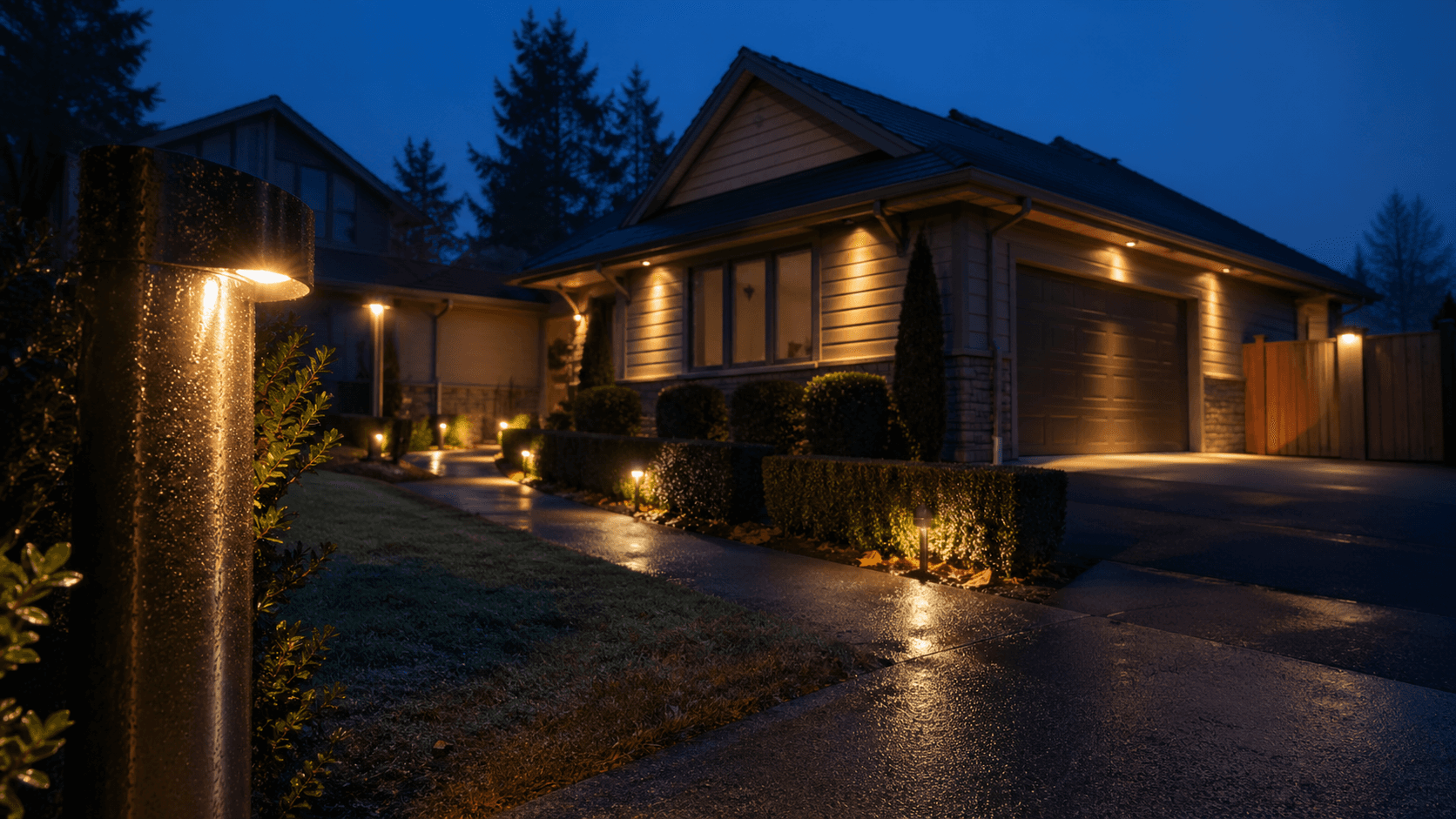
A burglar walks down your street at 2:14 a.m. He has a list of factors he is grading every house against, even if he could not name them in a sentence. Lights. Cars in driveways. Shrubs he could hide behind. Whether the porch is lit or shadowed. Whether a camera is staring back. He is not looking for a fight. He is looking for the soft target — the house that says, plainly, nobody will see me, nobody will identify me, nobody will prosecute me. He picks one and skips three. The three he skipped were not necessarily the ones with the biggest dogs or the loudest alarms. They were the ones that, on a quick walk-by, made his job harder than the dark house two doors down.
That is area denial. The military uses the term to describe terrain that the enemy chooses not to enter because the cost is too high. For a homeowner, area denial does not require a weapon. It requires that the approach to your home be so well-lit, so well-monitored, and so behaviorally hostile that an attacker votes with his feet and tries the next address. Lighting is the cheapest, most visible, most psychologically loud tool you have to make that vote come out your way.
In this article
- Tactical Exterior Lighting: Area Denial Without Firing a Shot
- The Doctrine: Three Functions of Tactical Exterior Lighting
- What the Burglars Themselves Tell Us
- Lighting Type 1: Continuous Low-Level Perimeter Lighting
- Lighting Type 2: Motion-Activated Floods Paired With Cameras
- Lighting Type 3: Path Lighting (For You, Not Resale)
- Layout Doctrine: Light the Lanes, Not Your Firing Positions
- Objections, Honestly Answered
- Spec Checklist: A Realistic Tactical Lighting Layout
- Lighting Is the First Layer, Not the Whole System
The Doctrine: Three Functions of Tactical Exterior Lighting
Lights on a house are not decoration. They do three jobs, in order of priority:
- Deterrence. The lit house is the one the attacker drives past. He never engages, never tests the door, never has to be confronted. This is the win.
- Detection. When something does cross your perimeter, light gives you and your cameras positive ID — face, clothing, vehicle, plate. Without light, even a 4K camera produces grain.
- Defense. A motion-triggered 3000-lumen flood at the back gate at 2 a.m. does not just record the intruder. It disrupts his OODA loop — observe, orient, decide, act — and gives you the orientation advantage while you call 911 from a hardened interior.
The U.S. Department of Justice and police departments across the country teach this framework as Crime Prevention Through Environmental Design (CPTED). The International CPTED Association formalized the principles in the 1990s; the short version is that an attacker reads the environment before he reads the lock. Lighting is one of the loudest things that environment says.
What the Burglars Themselves Tell Us
You do not have to take a security blogger's word for it. In 2013, criminologist Joseph Kuhns at UNC Charlotte ran a study funded by the Alarm Industry Research and Educational Foundation, surveying 422 incarcerated burglars across North Carolina, Kentucky, and Ohio. The findings, published in "Through the Eyes of a Burglar," are still the cleanest data on target selection we have.
The headline number for our purposes: when target selection is broken out by gender, female burglars in particular cited outdoor lighting, alongside alarms and outdoor cameras, as effective deterrents. Across the full sample, lighting was one factor among many — but the larger pattern of the study is unambiguous. Burglars actively skim for signs of increased security: alarm signs, dogs, cameras, and visible lighting. They look for the dark house, the quiet house, the house that signals no one is watching. Don't be the easy target.
The corollary matters more than the headline: lighting by itself does not stop a determined burglar. It changes the calculus. Pair it with a yard sign, a camera that pings your phone, a lock that holds for thirty seconds, and you have moved from "soft target" to "next house, please." For the layered model this fits inside, see echelons of defense: layered home security.
Lighting Type 1: Continuous Low-Level Perimeter Lighting
This is the workhorse. Dusk-to-dawn, low-wattage LED, placed at every avenue of approach to your home: driveway, side gate, every exterior door, the path to the garbage cans, the back fence line. The goal is not stadium light. The goal is no dead space. An attacker should not be able to pick a route to your house that passes through a black corridor.
Specs that actually matter
- Wattage: 5–10W LED per fixture is plenty. A 9W LED produces roughly the same visible output as a 60W incandescent and runs cool enough to sit in a sealed dome for years.
- Color temperature: Use warm white (2700K–3000K) for continuous perimeter lighting. Cooler 5000K "daylight" bulbs feel brighter but cast harsher, higher-contrast shadows that an attacker can hide inside. Warm light fills shadow more evenly, which is exactly what you want when the camera is trying to ID a face.
- Lumens: 400–800 lumens per fixture is the sweet spot for continuous perimeter coverage. Reserve the 2000+ lumen guns for motion triggers (next section).
- Foot-candles on the ground: The Houston Police Department CPTED guidance aligns with IESNA: target 1 foot-candle on walkways, ~3 foot-candles in driveways and parking. You can verify with a $20 light meter or a phone app.
- Uniformity: IESNA recommends an average-to-minimum ratio no worse than 4:1. Translation — no dark holes between pools of light. Dark holes are exactly where an attacker pauses.
Solar-powered perimeter lights have come a long way. A solar dusk-to-dawn fixture with a small Li-FePO4 battery will run all night and survive a grid-down event, which matters for the two-is-one, one-is-none redundancy mindset. Wire your primary perimeter to mains; back it up with solar at the corners and gates.
Lighting Type 2: Motion-Activated Floods Paired With Cameras
This is your detection-and-disruption layer. A 2000–3000 lumen LED flood with a passive infrared (PIR) sensor, mounted 8–10 feet up, angled down across an avenue of approach. Coverage zone roughly 30–40 feet, sensitivity dialed in so the neighborhood cat does not light it off twelve times a night.
The non-negotiable rule: pair every motion flood with a camera. Light without a camera is theater — it tells the attacker you noticed, but it gives you nothing usable when the police arrive. Light with a camera is positive ID — face, clothing, vehicle, direction of travel.
The NDAA reality check
The popular floodlight cameras you see at big-box stores — Ring, Eufy, Lorex, Reolink, Amcrest — are excellent products in their categories, but most are not NDAA Section 889 compliant. Their imaging chips, firmware, or parent companies trace back to manufacturers (Dahua, Hikvision, HiSilicon) that the U.S. government has restricted from federal use. For most homeowners that is an acceptable tradeoff. For preppers, veterans, current contractors, or anyone who simply does not want a Chinese SoC streaming their driveway feed, it is not.
If NDAA-compliant gear is a hard requirement, the floodlight-camera category narrows to manufacturers like Hanwha (Wisenet), Bosch, Axis Communications, Speco, and Vivotek — typically deployed as a separate PoE wired camera next to a dedicated LED flood, recorded to a local-only NVR, no cloud. It is more wire and more setup. It is also a system that does not phone home.
For the broader camera-selection logic, see our best home security systems comparison and the 2026 buying guide.
Lighting Type 3: Path Lighting (For You, Not Resale)
Builders sell path lights as a curb-appeal upgrade. For our purposes they have two tactical jobs:
- You move at night without a flashlight. Walking the dog, taking out trash, checking on a sound — you do it without lighting up your interior or silhouetting yourself in a doorway.
- The path is defined. An attacker stepping off the path into the shrubs is now in motion-flood territory and visibly off-route. The lit path channelizes legitimate traffic and makes illegitimate traffic obvious.
Use 2700K warm bulbs, low lumen (50–100 per fixture), shielded so the light hits the ground and does not blast eye-level. You want the path readable — not a runway.
Layout Doctrine: Light the Lanes, Not Your Firing Positions
This is where most homeowners get it wrong. They light the front yard like a Friday-night football field and leave the back fence in pitch black, then sit in a brightly lit living room with the curtains open. Inverted. Here is how to lay out lighting like someone who has thought about being inside the house when something happens:
- Light every avenue of approach. Driveway, walk, side gate, back gate, sliding-door patio, any window over a porch roof. The attacker should never find a dark route in.
- Eliminate dead space. Walk your property at midnight with the lights on. Anywhere you can stand unseen — behind the AC condenser, the corner where the fence meets the house, the crawl-space access, behind the shed — is dead space. Add a fixture or trim back what is creating the shadow.
- Trim shrubs to ~3 feet. CPTED's "natural surveillance" principle in plain English: nothing tall enough between waist and head height to hide a crouched adult. Tree canopies should start at 7 feet or higher. The attacker has nowhere to wait.
- Keep YOUR positions in shade. The window you would actually look out of, the corner of the porch you would step onto, the back deck you would clear from — those should be in relative dark. You want to outshine the threat, not be silhouetted by your own porch lamp.
- Preserve interior night vision. Outdoor floods do not reach the bedroom — close enough. Inside, use red bulbs in the rooms you would operate from at night (hallway, safe room, near the gun safe). Red preserves rod-cell adaptation; white light burns it off in seconds.
- Pair lighting with motion sensors and chimes so the light is not your only early warning. Light triggers, chime triggers, phone alerts — three independent signals reaching you in under five seconds. See motion sensors and early warning and door chimes and the OODA loop.
Objections, Honestly Answered
"Lights waste energy and run up my bill."
Per the U.S. Department of Energy, residential LEDs use at least 75% less energy than incandescent and last up to 25 times longer. A typical perimeter of eight 9W LEDs running dusk-to-dawn (about 12 hours) consumes roughly 0.86 kWh per night. At the U.S. average of ~$0.16/kWh, that is about $4.20 per month. Solar perimeter lights drop the operating cost to zero. The "energy waste" objection has not been true since 2015.
"Bright lights ruin my night vision."
Only if you stand inside the bright cone. Outdoor floods angled outward do not reach your eyes when you are inside the structure with curtains drawn. Use red bulbs in interior operating positions and you keep dark adaptation while the attacker takes the full 3000-lumen face wash. Outshine the threat is the doctrine.
"Lights advertise that I have something worth stealing."
This one is intuitive and wrong. The dark house signals no one is home or no one cares. The lit house with visible cameras and yard signs signals they will see me, ID me, and prosecute me. The Kuhns study and decades of CPTED data converge on the same conclusion: burglars pick the soft target, not the rich one. See why yard signs actually deter burglars for the same logic applied to signage.
"Won't this annoy my neighbors?"
Only if you do it wrong. Use shielded fixtures (full cutoff, IDA dark-sky compatible). Aim the cones down and inward across your property, not sideways into bedrooms next door. A tactically lit house should look intentional from the street, not garish.
Spec Checklist: A Realistic Tactical Lighting Layout
For a typical single-family home with a driveway, two side yards, and a back yard:
- Continuous perimeter (dusk-to-dawn): 6–10 fixtures, 9W LED, 2700K–3000K, 600–800 lumens, shielded. One at every door, one mid-driveway, one each side gate, one each back-corner of the yard.
- Motion-activated floods: 3–4 fixtures, 2000–3000 lumens, PIR sensor, ~30 ft range. One on driveway, one on each blind side of the house, one back yard. Each paired with a camera in the same housing or adjacent.
- Path lighting: 4–8 low-level (50–100 lumen) shielded fixtures along walkways and beds.
- Cameras: 4K, IR cut-filter, color night vision a plus. NDAA-compliant if it matters to you. PoE wired for primary, wireless only as supplements. Local-only NVR recording, cloud optional.
- Backup power: Solar dusk-to-dawn at the corners; UPS on the NVR and router. Two is one, one is none.
- Interior: Red bulbs in hallway, safe room, near safe. White elsewhere.
- Vegetation: Shrubs trimmed to ≤3 ft. Tree canopies started at ≥7 ft. No dead space at the foundation.
This is a one-weekend job for a comfortable DIYer with a ladder, or an afternoon for a low-voltage electrician. Most homeowners will pay $400–$1,500 in fixtures depending on quality and brand, plus camera/NVR cost separately.
Lighting Is the First Layer, Not the Whole System
Be honest with yourself. A perfectly lit house with no alarm, no cameras, no chime, and an unlocked back door is just a well-lit target. Lighting is the visible piece of target hardening — the piece the attacker grades from the sidewalk before he ever touches your property. It buys you the deterrence and the standoff. The alarm, the cameras, the locks, the safe room, and your own training carry the rest of the load.
If you would rather not spec all of this yourself, that is what concierge service exists for. We will walk your specific property — your avenues of approach, your dead spaces, your threat picture — and put together a lighting plan integrated with cameras, sensors, and monitoring that fits how you and your family actually live.
Spec your lighting + camera + sensor system with a concierge. No hard sell, no script — we look at your house, your neighborhood, your priorities, and tell you what we would put on it if it were ours.
For the broader monitoring decision (do you want a service watching your cameras, or do you want the feed coming straight to you?), see self-monitored vs. professionally monitored home security. The lights are the announcement at the curb. Everything else is what happens after the attacker reads the announcement and decides — like the smart ones do — to keep walking.