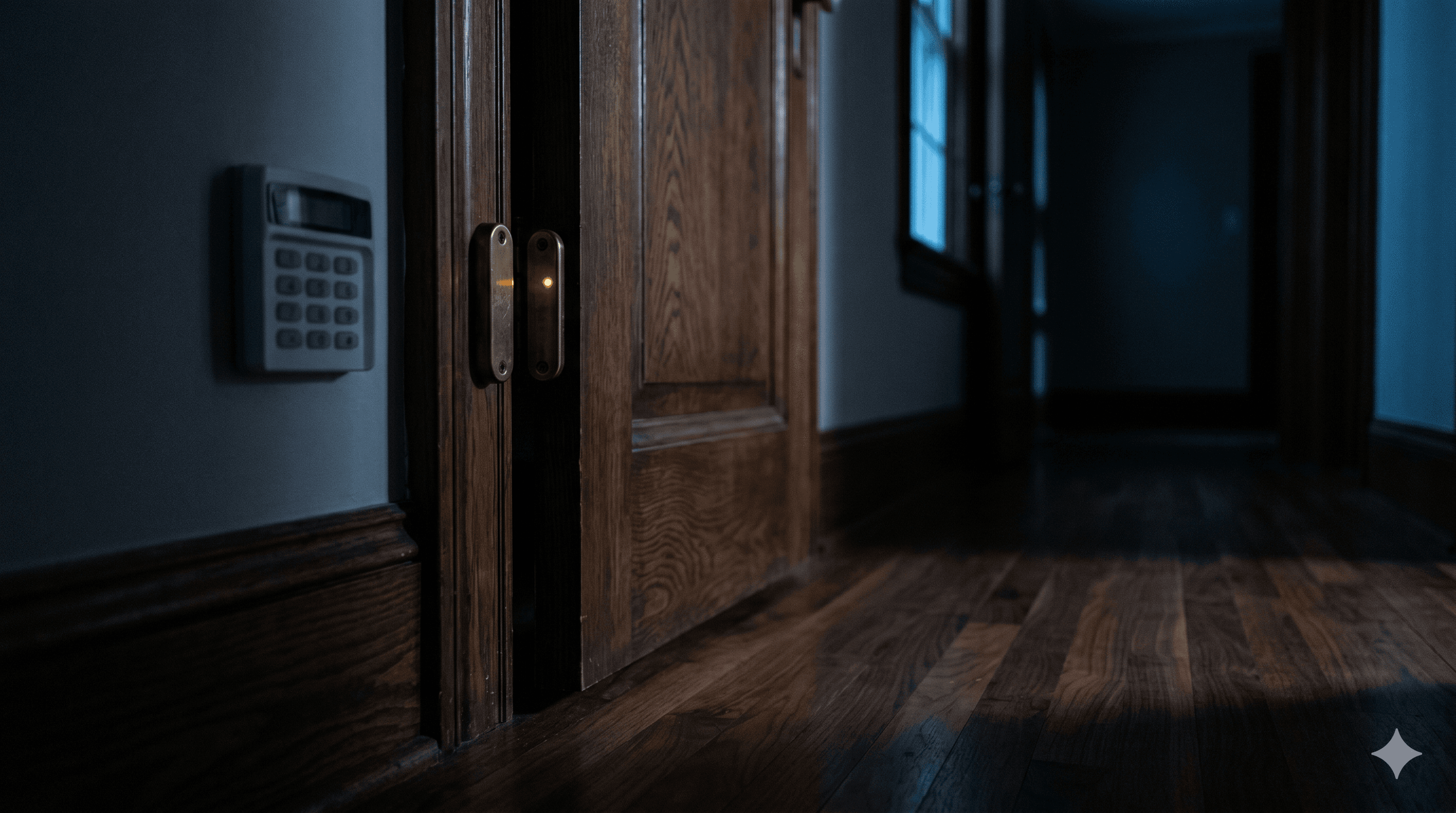
It is 2:14 AM. A floorboard creaks. You are awake before you know why. Your hand is already on the firearm in the bedside safe, and the most important question in your life right now is one most homeowners cannot answer in the dark: was that the back door, the front door, the basement walk-out, or your teenager coming home late?
That question — answered or unanswered — decides whether the next ninety seconds end with a hug, a phone call to police, or a tragedy you cannot take back. A two-dollar magnetic door contact wired to a chime answers it in under a second. That is the entire argument for this post.
In this article
- Door Chimes and the OODA Loop: Why an Audible Alert Saves Critical Seconds
- Why a Door Chime Is the Cheapest Force Multiplier in Your House
- The 97% Rule: Why PID Comes Before the Trigger
- "Which Door?" — Why Orientation Beats Volume
- The Gear: Building a Layered Audible Alert
- "I Have a Dog" — The Most Common Objection
- Rules of Engagement: What the Chime Lets You Do
- OPSEC, Gray Man, and the Quiet System
- Spec Checklist: A Chime System That Earns Its Keep
- What Happens After the Chime Fires
- Spec It Out
Why a Door Chime Is the Cheapest Force Multiplier in Your House
Col. John Boyd's OODA loop — Observe, Orient, Decide, Act — is the spine of every defensive decision you will ever make at home. Boyd's whole point was that whoever cycles the loop faster wins. The attacker who kicks your back door at 2 AM is already three steps in: he observed your house, oriented on the soft entry, decided to go, and is now acting. You are still asleep.
A door chime drops you into the loop at the same step he is on. The instant the contact breaks, you get an Observe input. The chime tone or voice prompt — "Back door open" — gives you Orient for free. Now you can Decide and Act with information instead of guesses.
Without the chime, the first thing you hear is footsteps in your hallway. You skip Observe and Orient entirely and are forced straight to Act. That is the ambush attacker's whole plan. A chime denies him that plan for the cost of a contact sensor and a wireless receiver.
The 97% Rule: Why PID Comes Before the Trigger
Tactical Professor Claude Werner has written what is probably the most-cited line in modern home-defense literature: "if you live with anyone else, my analysis is that there is a 97 percent probability that the 'bump in the night' is a member of your own household."
Read that twice. The overwhelming majority of nighttime noises in your home are not intruders. They are your kid sneaking in past curfew, your spouse getting water, the dog jumping off the couch, the cat knocking something over. Positive identification — PID — is not a tactical luxury. It is the line between a defensive shooting and shooting your own child.
A door chime is the first half of PID. It tells you a door opened, which one, and when. The second half is a camera at that door so you can see who it is before you ever raise the muzzle. Together they let you run the AOJ test — Ability, Opportunity, Jeopardy — with real information instead of adrenaline-fueled assumption.
Massad Ayoob has hammered the same drum from the other direction for decades: never search with a weapon-mounted light. A WML points the muzzle at whatever you want to identify. If "whatever" turns out to be your daughter, you have just violated rule two of firearms safety with the worst possible consequences. Use a handheld light to search, the WML to engage after you have PID. The chime + camera combo means most nights you never need to leave the bedroom to get that PID in the first place.
"Which Door?" — Why Orientation Beats Volume
A generic alarm siren tells you something is wrong. A chime with channel intelligence tells you where. That difference is the entire orientation step of the OODA loop.
Your bedroom door points one direction. Your kids' rooms are down a specific hall. Your safe room is somewhere specific. The fatal funnel — the doorway you have to clear or be cleared through — only matters if you know which one the threat is moving toward. A chime that announces "Front door open" versus "Basement door open" tells you in plain English:
- Which avenue of approach the person is using
- Whether they are between you and your kids, or you and the exit
- Which direction the muzzle should orient if it comes to that
- Whether the safe-room plan is "hold here" or "move now"
That is orientation. Without it, you are standing in the hallway in your underwear pointing a flashlight at noises. With it, you are already a step ahead of an attacker who assumed you would not know he was inside until he was on top of you. You are inside his OODA loop.
The Gear: Building a Layered Audible Alert
The good news is this is not expensive and it is not complicated. You are stacking three layers: sensor, annunciator, and verification.
Layer 1: Entry-Point Contact Sensors
Magnetic reed contacts on every exterior door, plus first-floor windows and any second-floor window reachable from a porch roof or fence. Hardwired is most reliable; Z-Wave or Zigbee wireless is fine if the panel supervises the sensor (battery-low alerts, tamper, supervision check-in). Honeywell, Bosch, GE, DSC, and Optex all make professional-grade contacts that have been in the field for decades. Avoid no-name imports — a contact that false-trips at 3 AM trains you to ignore the chime, which defeats the whole system.
Layer 2: The Chime Itself
Three flavors, pick at least two:
- Dedicated chime modules. A loud "ding-dong" or programmable tone every time a door opens, day or night. Useful, but it does not tell you which door.
- Voice-announcement panels. ADT Command, Vivint Sky, Ring Alarm Pro, Qolsys IQ Panel, and Alarm.com-based systems can announce the sensor name on open: "Front door. Back door. Garage door." This is the gold standard for orientation. Set it to whole-house at night, bedroom-only quiet chirp during the day.
- Per-zone tone codes. Older legacy panels can chime a different number of beeps per zone. Less elegant than voice, but workable if you memorize the pattern.
Volume matters. A chirp that does not wake you from REM sleep is decoration. Test it from a dead sleep — have a family member trip a sensor at 3 AM and see if you wake. If not, add a remote chime in the bedroom or turn the panel speaker up.
Layer 3: Verification — Cameras for PID
The chime tells you a door opened. The camera tells you who opened it. Pair every monitored door with a camera that pushes a snapshot or live feed to a screen you can see from the bedroom — phone, in-wall keypad, or a small dedicated monitor. A two-way-audio doorbell or porch camera also lets you issue a verbal challenge ("I see you, the police are on the way") without leaving the bedroom and without exposing yourself in the fatal funnel of a hallway. For NDAA-compliant options, look at Reolink's NDAA line, Amcrest, ADT-branded cameras, and any of the commercial-grade lines from Hanwha, Axis, or i-PRO. Avoid the obvious banned-list brands; our monitored-system roundup calls out which platforms ship NDAA-compliant hardware by default.
"I Have a Dog" — The Most Common Objection
A dog is a wonderful early warning. A dog is also a terrible reporting system. Your dog cannot tell you which door, cannot tell you whether the person at the door is your spouse or a stranger, and cannot operate in OPSEC mode — meaning a barking dog also tells the intruder you are awake and where you are. A chime is silent to anyone outside the house. It tips you without tipping the threat.
Two is one, one is none. Keep the dog. Add the chime. They cover each other's blind spots, and now you have a real layered system instead of a single point of failure with fur.
Rules of Engagement: What the Chime Lets You Do
Once you have time and information, your ROE expand dramatically. With three to ten seconds of advance notice and a known entry point, your decision tree looks like this:
- Verify on camera. Ninety-seven percent of the time it is family. Confirm and stand down. No firearm comes out.
- Call out. "Who's there?" from behind cover. Most legitimate household members will answer instantly. Most intruders will not.
- Retreat to the safe room. Gather kids, dial 911, take a defensive position behind hard cover with the muzzle oriented on the only avenue of approach. You are not clearing the house. You are holding ground until police arrive.
- Engage only if AOJ is met. Ability, Opportunity, Jeopardy — all three, with PID. Anything less and you wait.
Without the chime, that whole tree collapses to "wake up to footsteps and react." You skip everything that keeps you out of court and your family alive.
OPSEC, Gray Man, and the Quiet System
A serious chime setup is invisible from the outside. No yard sign required, no flashing strobes. The point is not to advertise — the point is to know. Keep the chime audio internal, keep the cameras local-first (on-prem NVR with cloud as a secondary, not the other way around), and keep the panel on a UPS so a power flicker does not blind you. Remote control of the system should ride on encrypted, vendor-direct apps — not third-party integrations that broaden your attack surface.
If you travel, the same chime network feeds your phone. Door opens at home while you are out of state? You know in two seconds, you check the camera, you call the neighbor or the police. That same intelligence layer works whether you are in the bedroom or three time zones away. See self-monitored vs. professionally-monitored for the tradeoffs on who else gets that signal.
Spec Checklist: A Chime System That Earns Its Keep
- Magnetic contacts on every exterior door and accessible window, supervised by the panel
- Voice-announcement panel (ADT Command, Ring Alarm Pro, Qolsys IQ, Vivint Sky) with per-zone naming
- Loud whole-house mode for night, quiet bedroom-only chirp for day, with bedroom remote chime
- Camera at every monitored door, snapshot-on-open pushed to phone and in-wall keypad
- Two-way audio at the front door and any commonly-used entry for verbal challenge
- NDAA-compliant cameras and recorder; avoid banned-list brands
- Local-first recording (on-prem NVR), cloud as backup, no forced-cloud-only platforms
- UPS on the panel and NVR; cellular backup on the alarm communicator
- Tested from a dead sleep — if it does not wake you, it does not count
- Integrated with the rest of your layered defense plan and exterior motion-sensor early warning
What Happens After the Chime Fires
The chime is the start of the loop, not the end. From the moment it sounds, you are running the same sequence the professionals run: PID before muzzle, cover before movement, communication before commitment. What happens after the alarm trips — dispatch sequence, police response timelines, monitoring-center protocols — is the next link in the chain, and worth reading before you need it. Pair that with the smart-lock guide if you want to know who unlocked the door before it ever opened.
The tactical professionals are unanimous on this point. Massad Ayoob's home-defense work emphasizes that "a firearm is not a home alarm system" — the firearm is the last layer, not the first. The chime, the camera, the contact sensor, the safe room, the family communication plan — those are the layers that make sure the firearm rarely has to come out at all. The USCCA's home-defense framework says the same thing in plain English: situational awareness and early warning are the foundation, and everything tactical is built on top of them.
Spec It Out
If you want a chime + sensor + camera setup designed around your floor plan, your sleep schedule, and your family's coming-and-going pattern — not a generic kit out of a box — Smart Security Concierge will spec it room by room with NDAA-compliant gear and local-first recording. Start a build with us here. No pressure, no hard sell. Just the right sensors on the right doors and a chime that wakes you up before the problem reaches your hallway.
The cheapest second you will ever buy is the one a door chime gives you at 2 AM. Buy it before you need it.