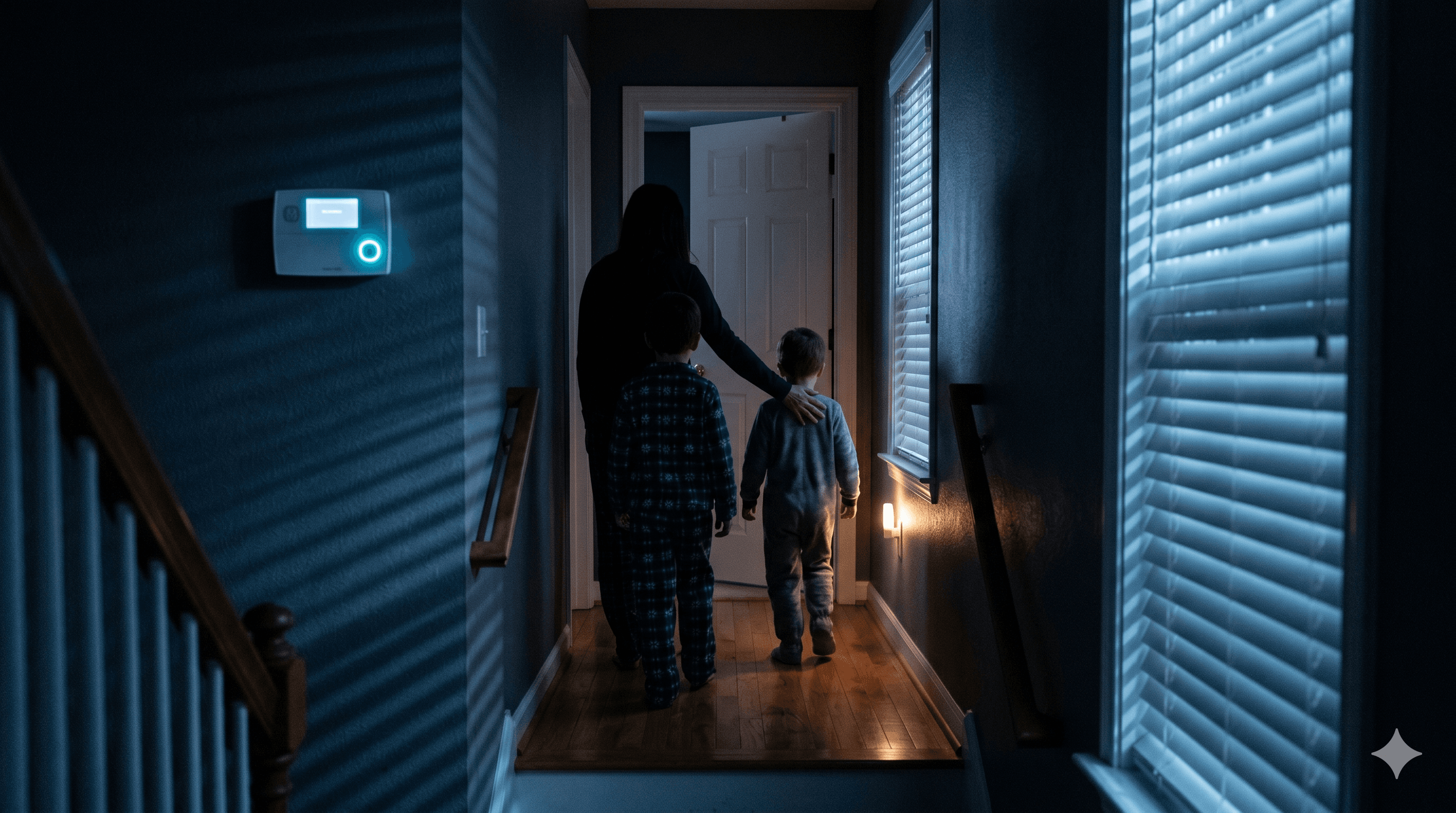
You probably have the gear. Cameras at the avenues of approach, door and window contacts, the chime that fires at 2 AM when somebody touches the back slider. A hard room with a reinforced door. A firearm in a quick-access safe, IFAK on the nightstand, maybe cellular backup for the panel.
What you almost certainly don't have is a rehearsed family drill.
Defense in depth is not just sensors and steel; it's people moving on a known plan when the chime fires. Without a drill, the gear is a noisemaker announcing a threat to a family that has no idea what to do. With a drill, the chime is a starting gun: armed responder to the door, kids consolidated, 911 on the line, positive ID before any trigger goes back. This is the human PACE plan.
In this article
- The Family Drill: What Happens When the Chime Fires
- Why Most Family Drills Don't Exist
- The Drill Philosophy: PACE for Humans
- The Roles: Who Does What
- The Code Word System
- The 911 Protocol
- The Drill Schedule
- Kids and Home Defense: Age-Appropriate Training
- Drill Trigger Scenarios to Rehearse
- The Legal and Ethical Layer
- Spec Checklist for the Drill
- The Bottom Line
Why Most Family Drills Don't Exist
When was the last time you ran a sleep-time chime fire and watched your family move? For most households, never. People rehearse fire drills because the school sends a worksheet home, tornado drills because the siren goes off in April. Almost no one rehearses the 2 AM glass break — the event their alarm system was built to detect.
Ayoob has been saying it for forty years: under stress you don't rise to the occasion, you fall to the level of your training. Force Science Institute research on officer performance under elevated heart rate confirms it: fine motor skills degrade, tunnel vision narrows, auditory exclusion kicks in, and any decision tree that wasn't pre-loaded is not there. This is why aviation runs sims and the military runs lanes. FEMA's Ready.gov family-plan template says the same thing: practice the plan regularly.
The Drill Philosophy: PACE for Humans
PACE is a military communications acronym — Primary, Alternate, Contingency, Emergency — and it is exactly the right shape for a home-defense family plan. You build four versions of your response, each one degraded a step from the last, so when the night doesn't go as expected you don't have to invent anything. Drilling without a foundation is wasted reps; if you have not yet covered the basics, our 25 home-safety essentials is the right primer to revisit before the next family drill.
Primary
Chime fires. Armed responder gets to the firearm and bedroom door, covering the avenue of approach. Non-armed parent consolidates the kids. Everyone converges on the hard room. 911 from inside. The version you'll execute 90% of the time.
Alternate
Armed responder is in a different room when the chime fires — downstairs, basement, bathroom. The geometry is wrong. They secure their position and treat it as a hard room of opportunity; the non-armed parent and kids shelter in place rather than crossing a contested hallway. The hard room doctrine adapts — any room with a lockable door and cover.
Contingency
Kids at sleepovers. One parent traveling. Armed responder alone. Pre-defined, written down, not improvised. Solo means shepherd and communicator compress into the armed responder. Decide in advance: clear or barricade? For most non-LEO civilians the answer is barricade. Decide on a Tuesday, not in the dark.
Emergency
Separated, can't reach the rally point. Pre-defined alternates the kids actually know — kid's bedroom with the lock, basement, backyard shed with a cached phone, neighbor's porch. Define them now or your teenager invents one badly.
The Roles: Who Does What
Three roles cover most households. Assign them by capability, not by gender or default. The armed responder is whichever parent is closest, fastest, and best-trained. The shepherd is whoever the kids will most readily follow without questioning. The communicator can be either parent or, for older kids, the teenager. Write the assignments down.
The Armed Responder
Firearm from the quick-access safe. Defensive position covering the most likely avenue of approach — top of the stairs, bedroom hallway. Calls out the code word so family in the dark knows it's them. Holds for positive ID before any decision to fire. Claude Werner — the Tactical Professor — calls it the 97% rule: if you live with anyone else, there's roughly a 97% probability the bump in the night is a household member. Werner puts the ratio at 32 to 1, family to intruder. The responder's primary job is PID. Engagement is the last resort, after AOJ — Ability, Opportunity, Jeopardy — is satisfied.
The Shepherd
Consolidates the kids. Quiet voice, hand signals, no phone screens or overhead lights. The load is the children — no stopping for valuables, no investigating sounds, no splitting up to "check on" anyone. Move, consolidate, lock the door.
The Communicator
Calls 911 from inside the hard room and stays on the line. Modern panels and camera apps let you view cameras from a phone — see controlling your system remotely — and the communicator becomes a force multiplier the moment they can relay live camera info to the dispatcher. A calm teenager can own this role.
The Kids
Pre-trained. At the chime, GO to the safe location. DO NOT come find Mom or Dad. DO NOT open the door for anyone without the code word in a parent's voice. DO NOT call out or light up a phone. The kid who runs to find a parent in the dark hallway during a clearing op is the kid who gets misidentified. The drill exists to prevent that.
Solo and Single-Parent Households
Roles compress; armed responder becomes shepherd-and-communicator. Firearm comes with you to the kids' rooms, consolidate in one hard room, call 911. Do not clear. The 11–25 minute police response is worth waiting out behind a locked door, not negotiating room-by-room with kids in the house.
The Code Word System
Code words keep the human element from collapsing into ambiguity. USCCA's home-defense planning material recommends a family code word as the silent plan activator. Extend that to a small system, each word with a specific job.
- Threat word — spoken by anyone discovering or suspecting a threat. Launches the PACE plan. "Bobcat" beats "I think someone's downstairs" because it's unambiguous.
- All-clear word — spoken by the armed responder once threat is neutralized or confirmed false. Family comes out only on this specific word in a parent's actual voice — not "it's okay," not "false alarm."
- Distress word — spoken under coercion. The agreement: "if I tell you 'we're fine, just a false alarm,' it's a hostage scenario; do not come out, call 911, stay locked in." A phrase that sounds normal and means the opposite.
- 911 verification word — when officers arrive, the dispatcher will give you the responding officer's name. Door does not open until that name is spoken. Your hedge against swatting and impersonators.
John Lovell at Warrior Poet Society has hammered this for years: words are cheap, code words are free.
The 911 Protocol
What the communicator says, in order. Write it down and tape it inside the hard room door.
- "There is an intruder in my home." Lead with the threat type.
- Your address. Say it twice — dispatchers report it's the most-misheard piece of info on emergency calls.
- Number of people in the home, where they are, that they are family. So responding officers do not shoot you when they enter.
- Description of the intruder, from the cameras if possible — height, clothing, what they're carrying. See pre-attack indicators on cameras for what to look for.
- Your own description, slowly. "I am a 5'11" male in a navy robe, master bedroom, second floor, end of the hall, armed with a handgun, I will keep it pointed away from the door when officers arrive and follow their commands." This sentence has saved homeowners' lives.
- Stay on the line. The dispatcher is your radio link to the responding units.
For the dispatcher's side, see how police respond to alarms and what happens when your alarm fires.
The Drill Schedule
Your family runs fire drills because the school district makes them. Run home-defense drills on the same logic.
- Quarterly verbal walk-through. Dinner table. Review roles, code words, rally points, 911 script. Ten minutes, four times a year.
- Annual full drill. Pick a night, pre-warn the spouse, tell the kids it's a drill but not when. Trigger the chime at sleep time. Watch the family move. Time it. Note what broke. Adjust.
- Update cadence. New house, new baby, kid off to college, new pet, new panel, new firearm setup — every life or gear change triggers a plan refresh.
Greg Ellifritz at Active Response Training has been writing for years: the difference between a household that survives a real event and one that doesn't is rarely gear. It's whether anybody had ever rehearsed.
Kids and Home Defense: Age-Appropriate Training
Toddlers (2 to 4)
One rule. "If you hear the loud sound, go to Mommy and Daddy's bed and stay there." That's it. The reflex you're building is "loud sound, go to a known location."
Elementary (5 to 10)
Safe location, threat word, all-clear word, no opening doors, what to do if separated. Practice quarterly at low stress — more like hide-and-seek than a tactical exercise. Muscle memory, not fear.
Tweens (10 to 13)
Now they can handle 911. Recite the home address — full street, city, ZIP. Full code word system including distress. Talk social media: what NOT to post during or after, why the alarm code and hard room location stay off Snapchat forever.
Teenagers (14 and up)
Old enough to be shepherd or communicator. The teenager who can work the camera app and relay descriptions to a dispatcher while a parent holds an angle is a genuine force multiplier. Train them on the 911 script and the distress-word system. Drivers get an alternate rally-point conversation: where to go if they pull up at 11 PM and the front door is open with an unfamiliar vehicle in the driveway.
Pets
Crate-trained dogs go to a known crate so they aren't moving in the dark during a clearing — getting your own dog shot happens. A barking dog is a force multiplier — see dogs as force multipliers — but a barking dog crossing a flashlight beam is also a PID problem.
Drill Trigger Scenarios to Rehearse
The drill is only as good as the scenarios you've walked. Cycle these annually.
- Ground-floor window glass break at 2 AM. The most common middle-of-the-night chime fire. Run the primary plan.
- Door knock at 11 PM, stranger asking for "Sarah." The classic casing pretext — see pre-attack indicators on camera. You do not open the door. You speak through the camera, you film, you call non-emergency or 911 depending on behavior.
- Garage contact alarm at 3 AM. The garage is the soft flank — see the garage as weak point. Armed responder covers the door from garage into house, not the front.
- Cellular outage during a real event. Comms PACE — landline in the hard room, satellite messenger, neighbor's house. There must be a Plan B.
- One parent traveling. Run the contingency plan. Solo means armed responder + shepherd + communicator in one person. Barricade, don't clear.
- Family split between rooms when the chime fires. Run the alternate plan. Who shelters where? When does each member move?
The chime starts the OODA loop — see door chimes and the OODA loop — and the drill is what collapses Observe-Orient-Decide-Act into a fraction of a second.
The Legal and Ethical Layer
The drill is not just operational; it is the legal precondition for acting when you have to. Massad Ayoob's AOJ test — Ability, Opportunity, Jeopardy — is the framework for justified deadly force. Pre-rehearsed PID dramatically lowers the chance of a negligent discharge or misidentification, and creates a record of due care that matters in any post-incident investigation. The Massad Ayoob Group's MAG-20 Armed Citizen's Rules of Engagement exists because "I had a plan and we rehearsed it" is a fundamentally different post-incident posture from "I heard a sound and I fired."
The case files are heartbreaking and not rare. In November 2025 an Indiana homeowner was arrested on suspicion of voluntary manslaughter after fatally shooting a 32-year-old house cleaner outside his front door — he reportedly had a designated safe room but no rehearsed PID protocol. A Virginia homeowner was charged with second-degree murder after firing on teenagers doing a "ding-dong ditch" prank. None of these happened because the homeowner lacked gear. They happened because there was no rehearsed protocol to slow the moment down.
Spec Checklist for the Drill
Print this. Tape it inside a closet. Run it on the quarterly review.
- Roles defined — armed responder, shepherd, communicator. Names written down.
- Code words — threat, all-clear, distress, 911 verification. Family-tested.
- Rally points — primary hard room, alternate per PACE, emergency external.
- 911 script written and posted inside the hard room.
- Kids trained age-appropriately — toddlers one rule, tweens 911, teens cameras.
- Pets accounted for. Crate location designated.
- Quarterly verbal review and annual full drill on the calendar.
- Plan refreshed at every move, life event, or gear change.
Any line empty? That's your homework for next weekend.
The Bottom Line
The chime fire is not the start of the fight. It's the start of a plan you and your family already executed, in slow motion, on a Saturday afternoon, six months ago. The gear bought you time. The drill is what you spend that time on.
If you're spec'ing a system to support the drill — chime at every avenue of approach, cameras with phone access, cellular backup, panel and display inside the hard room, sensors arranged in echelon, motion sensors providing early warning — we can help. Spec a system built to be drilled with.
Then go run the drill.