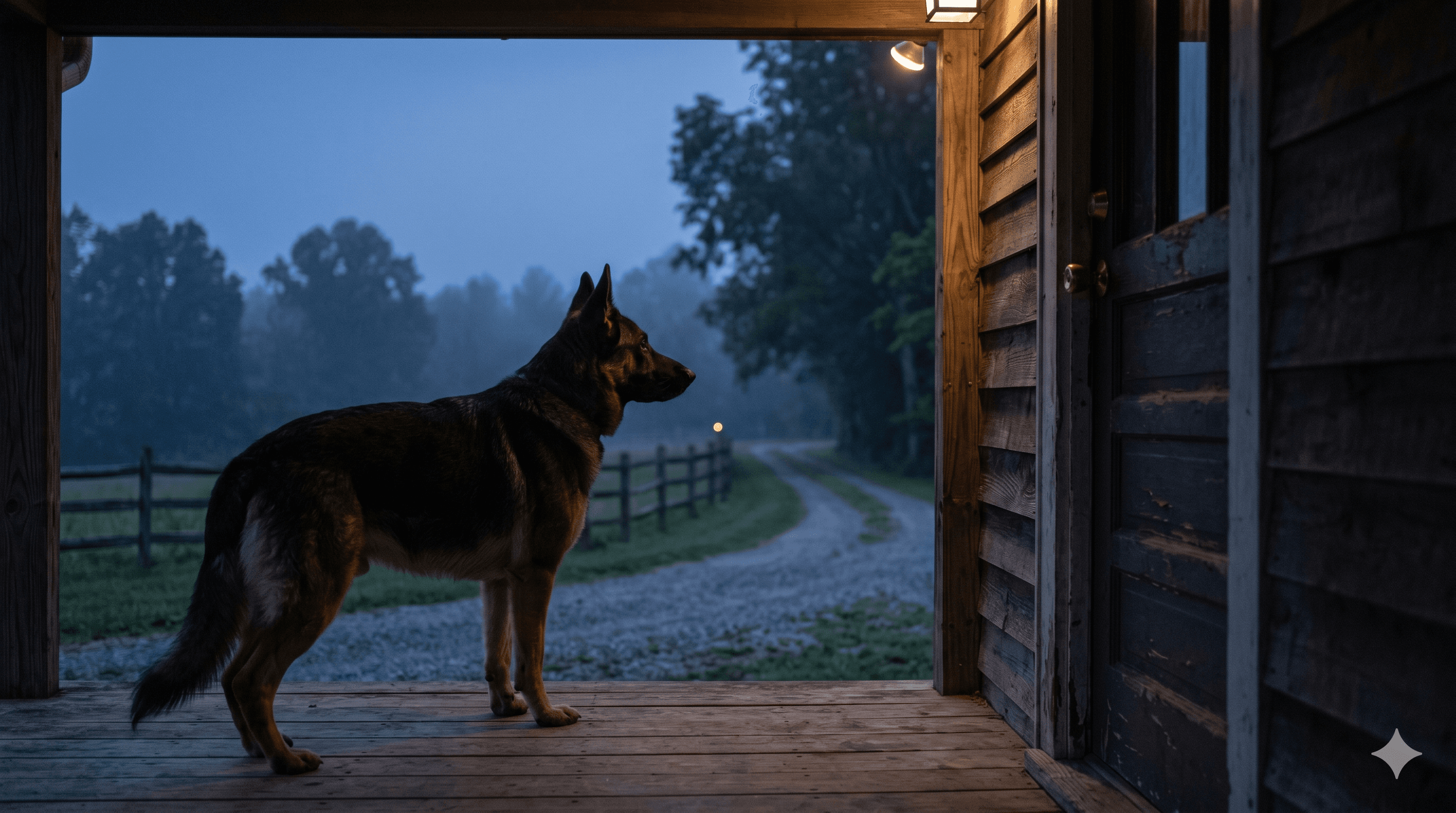
You already have the dog. Maybe a German Shepherd that follows your wife from room to room. Maybe a 12-pound terrier that loses its mind every time the UPS truck crests the hill. Either way, you understand at a gut level what most homeowners with a slab-built doorbell camera and a yard sign do not: a dog is the single oldest and most reliable early-warning system in human history. We domesticated wolves before we domesticated wheat. The doctrine has not changed in twelve thousand years.
What has changed is that your dog now has peers. Cellular-backed alarm panels. NDAA-compliant cameras with onboard AI person-detection. PIR/microwave dual-tech sensors. MURS driveway alarms that reach a thousand yards into the treeline. The question is not dog or system. The question is how to fuse them into a combined-arms layered defense where each element covers the other's blind spots. That is what a real force multiplier looks like — and that is what this piece is about.
In this article
- Dogs as Force Multipliers: Where Electronic Detection Falls Short
- Why The Burglar Studies Keep Putting Dogs Near The Top
- What A Dog Actually Does Well: The Doctrine Of Canine Early Warning
- Where Dogs Fail — And Why The Sensor Stack Has To Fill The Gap
- Combined Arms: Pairing The Dog With Electronic Detection
- Breed Selection — Practical, Not Romantic
- Training Basics Every Working Home-Defense Dog Needs
- What Cameras And Sensors Do That Dogs Can't
- The Spec Checklist — Combined Arms Layout
- Common Objections — And The Answers
- The Bottom Line
Why The Burglar Studies Keep Putting Dogs Near The Top
The single most-cited piece of evidence in this conversation is the UNC Charlotte burglar study, in which researchers interviewed convicted burglars about target selection. The findings: roughly 83 percent said they would try to determine if an alarm was present before attempting a burglary, and 60 percent said they would seek an alternative target if there was an alarm on-site. Burglars factored in "signs of increased security – including alarm signs, alarms, dogs inside, and outdoor cameras or other surveillance equipment" when picking targets. Dogs were not a footnote. Dogs were grouped with the hard countermeasures (UNC Charlotte burglary study).
The criminology literature backs this up beyond a single survey. The 2022 Social Forces paper "Paws on the Street" — Ohio State and UT Austin researchers analyzing 595 census block groups in Columbus — found neighborhood concentration of dog-owning households was inversely associated with robbery, homicide, and property crime, after controlling for demographics, prior crime, and spatial spillover (Paws on the Street, Social Forces). Cromwell, Olson, and Avary's older ethnographic burglar interviews and Miethe (1991) reached the same conclusion from different angles.
What surprises people is that the deterrent effect is not limited to working breeds. Burglars in interview after interview describe small loud dogs — yappers, terriers, mini schnauzers — as a hard pass. A barking 14-pound dog wakes neighbors, defeats stealth, and creates exactly the kind of noise and unpredictability a burglar is trying to avoid. Greg Ellifritz at Active Response Training points to a US Department of Justice burglary report finding that "on average, burglarized houses are less likely to have dogs than are non-burglarized houses, suggesting that dog ownership is a substantial deterrent" (Ellifritz, Active Response Training). He's also clear-eyed about the limits — more on that below.
What A Dog Actually Does Well: The Doctrine Of Canine Early Warning
If you read the layered-defense literature — Rawles, Lovell, the Schutzhund/IGP community — the dog occupies a specific job in the stack. Outermost organic sensor. Detection layer 1. Here is what the dog brings that no $400 PIR sensor brings:
- Detection at biological range. A dog's olfactory acuity is roughly 10,000 to 100,000 times more sensitive than ours depending on the metric. Hearing covers a frequency range humans can't access and detects sounds at four times the distance. Your dog hears the truck at the bottom of the driveway before you hear the gravel.
- Discrimination of the unfamiliar. A PIR doesn't know if the person in the yard is your son or a stranger. A dog absolutely knows. Familiarity is encoded across multiple sensory channels — scent signature, gait, voice — and a dog's alert behavior to "stranger" is materially different from "household member." That's data your sensor stack can't generate.
- Audible alarm the homeowner intuitively trusts. Most homes with monitored systems suffer from chime fatigue — every PIR trigger sounds the same and 99 percent of them are nothing. A dog escalating from a single woof to sustained barking carries information your nervous system already knows how to read. You wake up and your OODA loop is already in Observe.
- Force-multiplier effect inside an engagement. If a burglar does breach, he's now facing two threats — an armed homeowner and a dog. Most criminals are not trained to handle either, let alone both. The dog draws attention, fixes the attacker in place, and buys you the seconds you need to gain positive ID and act.
- Round-the-clock alertness, especially with multiple dogs. Two dogs naturally rotate sleep cycles. One is up when the other is down. A single dog is a single point of failure (two is one, one is none).
For the audience that already lives this — Schutzhund/IGP titled dogs, working-line Mals, Dutchies, GSDs — none of this is new. For the homeowner who bought a Lab from a breeder because the kids wanted one, the lesson is that even an untrained family dog covers more sensor ground than the average $1,500 retail security package.
Where Dogs Fail — And Why The Sensor Stack Has To Fill The Gap
Here is the part that gets glossed over by the "just get a dog" crowd. Dogs fail in specific, predictable ways. If you build your home defense around a dog without an electronic layer, you have built a castle with one wall.
- Dogs sleep. Even working dogs sleep 12-14 hours a day. A determined intruder who watches your property for a week knows when.
- Dogs get bribed. Many breeds — retrievers especially — are food-motivated to a fault. A steak through the fence buys silence cheaper than you'd like to believe. Burglars in multiple jurisdictions have been documented using drugged meat or tranquilizer-laced bait to neutralize dogs before entry. Outside the US it's so common that veterinary associations issue periodic warnings about it.
- Dogs get distracted. Puppies chase squirrels. Intact males chase scent. The dog that should be watching the back fence is at the front window losing his mind at the mail truck.
- Dogs do not record. If a burglar gets past the dog, you have zero evidence. No video. No timeline. No prosecution case. No insurance documentation. The dog's testimony does not hold up in court.
- Dogs alert but don't orient. Your dog tells you "someone is somewhere." He cannot tell you "back door, two subjects, one carrying a long gun." That orienting information has to come from sensors, cameras, and contacts wired to a chime panel.
- Dogs get hurt. Pepper spray, bear spray, knives, and firearms are all carried by intruders who know dogs may be present. A dog absorbing the first burst of OC is a dog out of the fight.
- Dogs cannot differentiate the FedEx driver from a burglar casing the property. Both are strangers. Both walk up the driveway. Without a camera with AI person-detection and a recorded history, you have no way to identify casing behavior or recognize pre-attack indicators after the fact.
- Dogs age. Hearing degrades. Smell degrades. The 11-year-old GSD who was a wall five years ago sleeps through the chime now. If you only have one dog, you lose meaningful detection capacity every 3-5 years.
None of this is an argument against dogs. It is an argument that a dog is one layer in your echelons of defense — not the whole defense.
Combined Arms: Pairing The Dog With Electronic Detection
The doctrine is straightforward: the dog is layer one organic detection, the sensor stack is layers two through four, and they cross-check each other constantly. Here is what that looks like in practice.
Outer Perimeter — Driveway Alarm + Dog
The dog handles the area he can see, hear, and smell — typically 50 to 150 yards depending on terrain and breed. Beyond that is dead ground. A Dakota Alert MURS driveway alarm covers 1,000+ yards line-of-sight and gives you a discrete chime at the panel before the dog ever hits scent. When the driveway alarm fires and the dog isn't yet alerting, you know something is approaching from outside the dog's bubble. When the dog alerts and the driveway alarm hasn't fired, you know it came in across the woodline, not down the road. The two together orient direction. See motion sensors as outermost early warning for the full layout.
Mid Perimeter — AI Cameras Correlating With Dog Alerts
This is where modern systems earn their keep. NDAA-compliant cameras from Reolink, Lorex, or Amcrest with onboard AI person-detection generate a separate alert stream. The discipline is correlation: if the dog barks and the camera shows a person, that's positive ID. If the dog barks and the camera shows nothing, it's probably wildlife and you can stand down. If the camera detects a person and the dog isn't alerting, something is wrong — the dog is asleep, on the wrong side of the house, or out of position. That mismatch is itself information. You don't get that out of a dog alone, and you don't get it out of cameras alone.
Inner Perimeter — Door Chimes For Orientation
The dog tells you "someone breached the perimeter." A door/window contact wired to a chime panel tells you exactly which door. That's the difference between sweeping the whole house in your underwear and moving directly to the entry point with intent. This is the OODA loop compression that converts a panicked homeowner into an oriented defender. See door chimes and the OODA loop for why this matters more than people realize.
Lighting And Yard Signs
Don't sleep on the cheapest layers. Tactical exterior lighting for area denial denies the cover of darkness a casing intruder relies on, and a barking dog under 200 lumens of motion-triggered light is a much harder problem than a barking dog in the shadows. Alarm yard signs stack the deterrent: "Beware of Dog" + monitored alarm placard + visible camera changes the math on the casing decision.
Breed Selection — Practical, Not Romantic
The home-defense community oscillates between two bad poles: "any dog works" and "you need a $25,000 protection-trained Malinois." Neither is right. Treat breed selection like rifle selection — match the tool to the mission.
Working And Herding Breeds For Active Deterrence
German Shepherd, Belgian Malinois, Dutch Shepherd, Doberman, Rottweiler, Cane Corso, Giant Schnauzer. These dogs were bred to do work. They will alert, engage, and intimidate by their mere presence. Caveats are real:
- Training-intensive. A working-line Mal with no training and no job is a household catastrophe. A pet-line GSD without structure becomes anxious and reactive.
- Exercise demands. 60-90 minutes of real work per day, minimum, for the high-drive lines.
- Liability. Insurance carriers redline some of these breeds. Bites carry civil and criminal exposure. A poorly trained large dog is not an asset, it is a lawsuit waiting to be filed.
Vocal Alert Dogs Of Any Size
Beagles, Miniature Pinschers, Schnauzers (any size), Australian Shepherds, Shelties, even Chihuahuas. Burglars hate them precisely because they alert without offering a confrontation the burglar can resolve with violence. A 14-pound dog barking through a window is a noise problem, not a fight problem — and noise is the burglar's worst enemy.
Velcro Dogs That Stay With The Family
Some retrievers, some shepherds, many of the working breeds. You want a dog that defaults to your location, not one that wanders to the back forty when the alarm goes off. In a real engagement, the dog at your hip is worth ten dogs in the yard.
For any dog, get the AKC Canine Good Citizen certification as a baseline behavioral standard before you even think about protection work. For working-dog programs, look at Highland Canine Training — North Carolina based, 25+ locations, IACP Platinum sponsor, with dedicated police K9 and protection divisions. Schutzhund/IGP clubs through the United Schutzhund Clubs of America offer the gold standard of working-dog evaluation: tracking, obedience, and protection scored under judges with decades in the sport.
Training Basics Every Working Home-Defense Dog Needs
You do not need a $20,000 personal protection dog to have a useful animal in your defensive plan. You do need these:
- Recall. When you say come, the dog comes. Off leash, under distraction, every time. Without this, every other capability is theoretical.
- Quiet / stop command. Critical for OODA. There are moments where you need the dog to shut up immediately so you can hear footsteps or radio traffic. A dog that barks indefinitely once triggered is destroying the audio picture you need to act.
- Place / crate command. Send the dog to a known location and have him stay there. This is how you safely clear a hallway without shooting your own dog. A crate-trained dog can be locked down in seconds when LE rolls up.
- Bite-and-release with a verbal cue if you've gone the protection route. Out is non-negotiable. A dog you cannot call off is a dog that will end your shooting career and possibly your freedom.
- Gunfire and noise desensitization. The dog has to function around suppressed and unsuppressed fire, sirens, breaking glass, and the panic of household members. Start at low decibel at distance and build over months. A dog that flees the first round is worse than no dog.
What Cameras And Sensors Do That Dogs Can't
This is the other half of the combined-arms argument. The sensor stack is not a luxury. It does specific jobs the dog cannot do.
- 24/7 recording for evidence. Insurance, prosecution, civil defense if you end up in court yourself. The dog cannot text you the video. See does home security lower homeowners insurance for the carrier-side incentive.
- Cellular alert when you are not home. The dog barks at 3 AM and you are at work. Without cellular-monitored alarm and push notification from cameras, that bark dies in an empty house. The best monitored home security system is the bridge between a home alone with a dog and a homeowner who can act on what the dog detects.
- Perimeter detection beyond the dog's range. MURS-band driveway alarms reach a mile. No dog does.
- Positive ID at night. A dog can tell you "stranger." A 4MP starlight camera with IR can tell you "stranger, male, 5'10", dark hoodie, carrying a pry bar."
- Mismatch detection. When the camera sees a person and the dog doesn't react, the system has just told you something the dog couldn't.
For the comparative shopping side, see best home security systems comparison.
The Spec Checklist — Combined Arms Layout
If you are spec'ing a system around a dog you already own, this is the build:
- The dog. CGC minimum, working obedience preferred. Recall and quiet under distraction.
- Driveway alarm. Dakota Alert MURS for outer ring early warning. Battery + solar option for properties with no power at the driveway head.
- Perimeter cameras. 4-6 NDAA-compliant cameras (Reolink, Lorex, Amcrest) with onboard AI person-detection, IR or starlight night capability, hardwired PoE.
- NVR with local recording. Hard-wired, 30-day minimum retention. Hardware separate from the cloud so a cut internet line doesn't cost you the evidence.
- Door / window contacts on every entry, piped to an audible chime panel for orientation.
- Dual-tech motion sensors (PIR + microwave) inside, configured to require both technologies to fire — this filters most pet motion from your own dog.
- Cellular-backed monitored alarm panel with battery backup. See communications redundancy for why cell + battery is non-negotiable.
- Hard room with the family + dog. Reinforced interior door, comms, weapons, lighting, and the dog locked down with you so nothing gets shot that shouldn't.
Common Objections — And The Answers
"I have a dog, I don't need cameras." Your dog cannot text you the video at 3 AM when you're at work. Your dog cannot tell you which door was breached. Your dog cannot generate the evidence your insurance carrier and the DA need to make you whole and put the offender away. The dog is layer one. Cameras and sensors are the rest of the layers.
"Cameras and sensors trigger constantly because of my dog." Solved problem. AI person-detection on modern NDAA-compliant cameras filters out animals at the model level — a 70-pound shepherd is not classified as a person. Activity zones can exclude pet-height ranges entirely. Dual-tech indoor sensors require both PIR and microwave to fire, which filters virtually all pet motion. If your installer is still telling you "you have to choose between a dog and motion sensors," fire your installer.
"My dog will handle anything that comes through the door." Maybe. Greg Ellifritz documents multiple cases where large aggressive dogs were defeated — by pepper spray, by bait, by a determined attacker with a knife or firearm. You do not want your dog to be the last line of defense. You want him to be the first line of detection, with you behind a hard room door, behind a chime panel, behind monitored cellular alarm, behind a camera stack that's already pushed video to your phone and to a monitoring center. Layer everything.
The Bottom Line
The dog is the oldest force multiplier on your property. The criminology backs it up — UNC Charlotte, Social Forces, Cromwell, Miethe, the DOJ data Ellifritz cites. But the dog has predictable failure modes that the sensor stack is specifically built to cover, and the sensor stack has blind spots — discrimination of the unfamiliar, intuitive trust, scent and sound at biological range — that only the dog can fill.
Run them together. The dog tells you something is wrong. The driveway alarm tells you it came from the road. The camera tells you who and how many. The chime tells you which door. The cellular panel tells the monitoring center, who tells law enforcement. The dog is at your hip in the hard room while you wait. That is combined arms. That is what a real layered defense looks like.
If you want help speccing the electronic half of that — driveway alarm, NDAA-compliant camera stack, door/window contacts wired to a chime, cellular and battery-backed panel, the works — tell us about your property and your dog. We'll build the system that complements the animal you already trust, not one that fights with him.