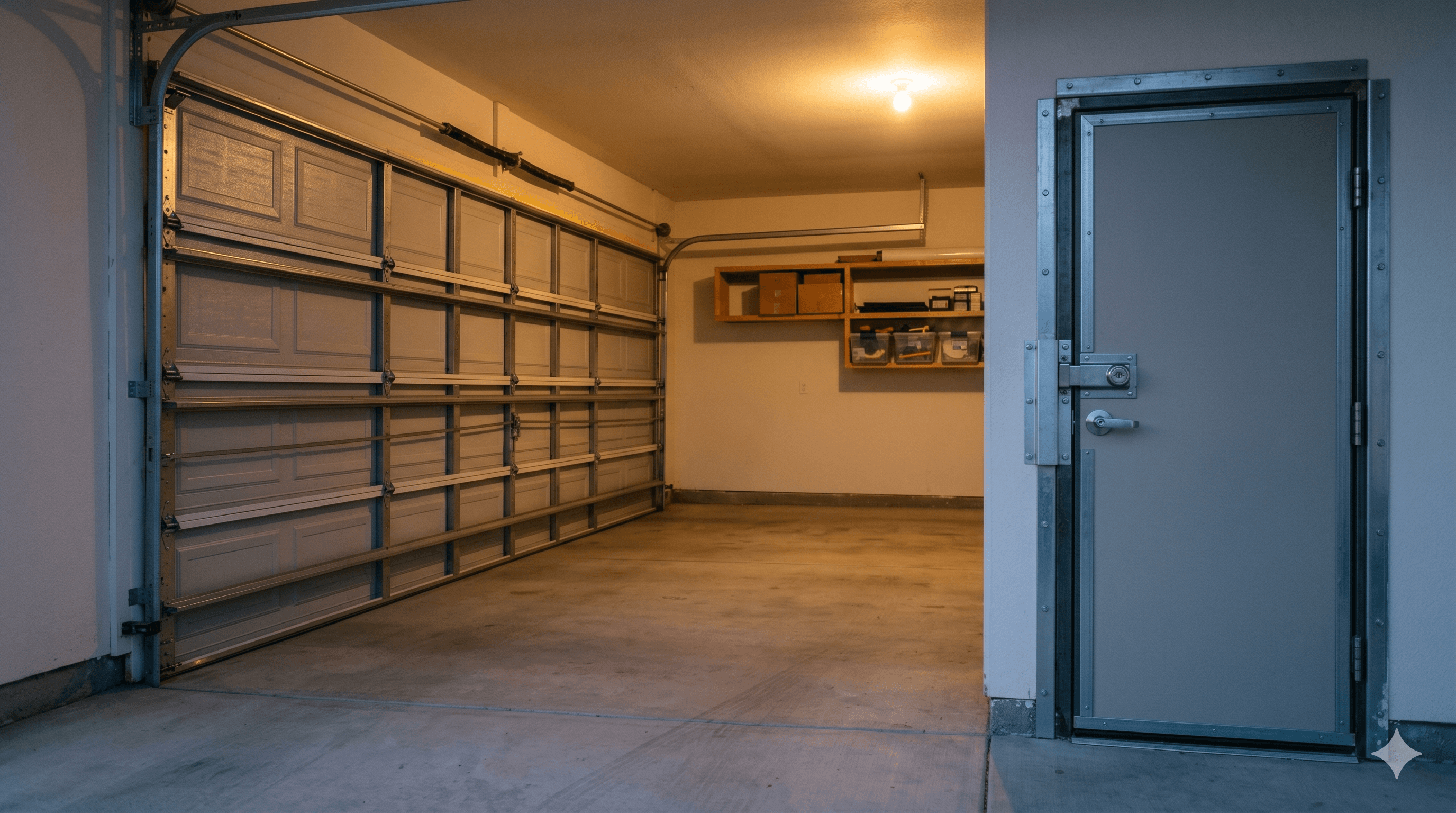
Most home-defense planning starts at the front door. Reinforced strike, Grade 1 deadbolt, maybe a video doorbell. Good. Now walk twenty feet right and look at the eight-by-sixteen panel hanging from a piece of bent steel and a $40 motor. That is your soft flank. The attacker knows it. The cop who took the report on your neighbor's break-in knows it. The only person who often hasn't internalized it is the homeowner.
An attached garage is, in operational terms, an enclosed staging area bolted to your house. Once an attacker is inside it, they have privacy, no neighbor sightlines, and as much time as they want to work on the interior door — the one between the garage and your sleeping family. This post is about closing that gap.
In this article
- The Garage Is Your Soft Flank: Securing the Most Common Entry Point
- Why the Garage Is the Soft Flank
- Threat 1: Radio Attacks on the Rolling Door
- Threat 2: The Coat-Hanger / Zip-Tie Defeat
- Threat 3: The Side Man-Door (Garage to Outside)
- Threat 4: The Interior Door (Garage to House)
- Threat 5: The Garage as Staging Area
- Threat 6: The Camera Blind Spot
- The Smart Garage Controller Layer
- Spec Checklist (Priority Order)
- Closing the Flank
Why the Garage Is the Soft Flank
The FBI's UCR program tracks residential burglary through the Crime Data Explorer. The headline — burglary continues a long downward trend — is true. The composition has shifted. Front-door kick-ins are loud. Garages are quiet. Industry tracking now puts garage-door entries at roughly one in eleven residential burglaries, and when you bundle the side man-door and the garage-to-house door, the attached structure is one of the top avenues of approach in the country.
The UNC Charlotte burglar study — Joseph Kuhns surveying 400+ incarcerated burglars — found most enter through open or forced doors and windows, and 60% pick a different target if they see an alarm. The implication is brutal: a side door with a hollow core and a $12 knob is an open door in their eyes. So is a rolling door whose release can be defeated with a coat hanger. Greg Ellifritz has written about this; Massad Ayoob has been pointing out the garage-as-staging problem for decades. Defense in depth means treating the garage as an exterior threat surface.
Doctrine: if the front door is your bow, the garage is your flank — and flanks lose battles. For the broader framing of layered defense, see Echelons of Defense: Layered Home Security.
Threat 1: Radio Attacks on the Rolling Door
The remote in your visor talks to a receiver on the opener. How that conversation is encoded determines how hard it is to forge.
- Fixed-code openers (DIP-switch units, pre-mid-2000s installs, and a lot of cheap aftermarket gear sold today) transmit the same code every press. A code grabber pulls it once and replays it. Time-to-target: seconds, from a parked car at the curb.
- Rolling-code openers — LiftMaster Security+ and Security+ 2.0, Genie Intellicode, Chamberlain — change the code on every press from a synchronized counter. Replay attacks fail. Security+ 2.0 added tri-band operation to harden against jamming. This is the floor for a serious install.
- Legacy and budget brands still ship gear without true rolling code, especially aftermarket keypads and universal remotes. Two is one, one is none — don't trust the sticker; pull the model number.
Defenses, in priority order:
- Replace any opener older than ~2011 or any unit you can't positively identify as rolling-code.
- Add a smart garage controller (myQ, Garadget, Aladdin Connect) so the opener reports state and tamper events to the panel.
- Install a magnetic contact sensor on the rolling door itself, paired to the panel — independent of the opener. If the door moves while armed, the panel screams.
- Pair the chime/contact layer with the rest of your early-warning sensor doctrine.
Threat 2: The Coat-Hanger / Zip-Tie Defeat
This is the most common physical attack on residential garages, and it requires no skill and no electronics. The red T-handle hanging from the trolley exists so a person trapped inside during a power outage can disengage the door and lift it manually — an NFPA-aligned fire-egress feature. From the outside, it's a one-step defeat.
The technique: slide a hooked piece of stiff wire through the weather seal at the top center of the door. Hook the release cord. Pull. The trolley pops, the door is mechanical, and one hand lifts it. SFPD's Taraval Station has documented this in their crime-prevention bulletin: a closed roll-up garage opens in seconds with a coat hanger. Time-to-target: 6–10 seconds. Skill required: none.
Defenses, in priority order:
- Garage Shield / Garage Door Defender-class products physically block tool insertion above the trolley while leaving the release functional from inside. The Garage Shield's own write-up is honest about the tradeoffs of the cheaper alternatives.
- Zip-tying the release lever to the trolley — works against the coat-hanger attack, but can defeat fire egress. Only do this with a written, drilled plan to cut the tie from inside. Build it into your family defense drill.
- Garage door lock bar / track lock that physically pins the door tracks. Cheap, mechanical, no power required. Right answer for the OPSEC-conscious household.
- Smart garage controller with tamper alerts — myQ Security+, Garadget — fires an alert the instant the door moves while armed, even if the attacker bypasses the motor.
Doctrine: a single defense is a hope. Stack at least two.
Threat 3: The Side Man-Door (Garage to Outside)
Walk into most attached garages and look at the side door — the one to the yard or the walkway between houses. You'll find a hollow-core or thin stamped-steel slab, a builder-grade knob with no deadbolt, a strike plate held by three half-inch screws into pine, and a paper-thin jamb. This is often the easiest entry point in the envelope, and because it's tucked beside the house, it's invisible from the street.
Treat the garage man-door as exterior-grade. Not "interior plus a deadbolt." Exterior-grade. Spec:
- Solid-core or steel-skinned 1-3/4" door.
- BHMA Grade 1 deadbolt — Schlage B60N or equivalent — or a hardwired smart lock with Grade 1 cylinder.
- Door Devil, StrikeMaster, or equivalent jamb reinforcement, fastened with 3" deck screws into the king studs (not the jamb).
- Magnetic contact sensor with chime tied to the panel.
- NDAA-compliant PoE camera (Reolink, Lorex, Amcrest) covering the approach to the door, with AI person-detection so you aren't crying wolf at every leaf.
For the full hardening playbook on this class of door, see Door and Window Hardening: The Delay Echelon.
Threat 4: The Interior Door (Garage to House)
This is the door that protects sleeping family. In most tract-built homes it's a hollow-core slab with a $15 knob and a 20-minute fire rating earned by cardboard and prayer. Once an attacker has compromised the rolling door or the man-door, they are inside an enclosed, hidden room with as long as they want to defeat this final barrier. That is an unacceptable tactical posture.
Doctrine: treat the interior garage-to-house door as exterior-grade, not interior-grade. Spec:
- Solid-core door, 1-3/4". A steel-skinned door is better; a fire-rated solid core is the minimum.
- BHMA Grade 1 deadbolt with a reinforced strike — and per NFPA egress conventions, thumb-turn from the inside, no double-cylinder. You must be able to escape without a key.
- A smart lock with tamper and forced-entry alerts. See our complete guide to smart locks for the model-by-model tradeoffs.
- Magnetic contact sensor with audible chime — separate zone in the panel, so a 2 a.m. trip on this sensor is unmistakable in your family action plan.
- A camera inside the garage covering this door, so you can clear before you open it under stress.
The fire-code wrinkle is real and the answer is simple: NFPA and the IRC require unimpeded egress, which a single-cylinder thumb-turn deadbolt provides. You don't have to choose between defense and life-safety; you have to install it correctly.
Threat 5: The Garage as Staging Area
An attacker who compromises your garage once — even if they never reach the house — has gained a private staging room. Implications people rarely think through:
- Tools left behind for a return visit. The "I could have sworn that hammer was in the toolbox" feeling.
- Stolen goods or contraband stashed between jobs. If found there, you are the one explaining it.
- Anything you store in the garage is in scope. Bug-out bag? Spare ammo cans? Gun safe overflow? It's all in reach.
OPSEC consequence: the garage is not safe long-term storage for anything you'd lose sleep over. Pull ammo cans, optics, kit, and the BOB inside. Drill the rule into the family: if the garage door is up when it shouldn't be, treat the house as compromised until cleared. That decision tree belongs in your home-defense action plan.
Threat 6: The Camera Blind Spot
Most homeowners point one camera at the front door, one at the driveway, and call it covered. The garage interior is invisible. The man-door is invisible. The attacker who's in the rolling-door box working on the interior door is completely off camera. Fix it.
- One NDAA-compliant PoE camera inside the garage, mounted high in the corner, framing both the rolling door and the man-door. Reolink, Lorex, and Amcrest all ship qualifying models. Avoid Hikvision/Dahua-OEM gear.
- One PoE camera outside, covering the driveway approach to the rolling door and the side man-door. AI person-detection mandatory; you'll get nuisance alerts otherwise.
- Hardwired NVR with local-only recording. No cloud dependence. No subscription. If the internet is out — or cut — the recording continues.
- Battery + cellular backup on the alarm panel so a "phone line cut, then garage breached" sequence still phones home.
For the broader sensor architecture this fits inside, including window-pane coverage that a garage-staging attacker might pivot to, see glass-break sensors and home defense.
The Smart Garage Controller Layer
A smart garage controller is the connective tissue between opener, panel, and phone. The point isn't convenience; it's the tamper alert — the door opened when it shouldn't, the door is still open at 11 p.m., the door opened while you're 200 miles away. Options:
- myQ Security+ (LiftMaster/Chamberlain) — broadest install base, deepest integration with Security+ 2.0 openers, geofence close-confirm, schedule-based locking. Cloud-dependent.
- Garadget — laser-based door-state sensor, REST API, friendlier to Home Assistant and local automation than myQ.
- Aladdin Connect (Genie) — Genie's native solution, comparable feature set.
OPSEC caveat: most controllers funnel state through the vendor's cloud. For households that want zero cloud dependence, look for ones with local control or Home Assistant integration, and pair them with a panel-level contact sensor as your authoritative sensor of record. The smart controller is a force multiplier; the contact sensor is ground truth. For more, see controlling your security system remotely.
Spec Checklist (Priority Order)
If you do these in order, every dollar buys more security than the last.
- 1. Confirm Security+ 2.0 (or Intellicode) opener. Pull the model number; verify against manufacturer spec. Replace if fixed-code or unknown.
- 2. Defeat the manual-release attack. Garage Shield / Defender product, plus a track lock bar, plus contact sensor on the rolling door. Stack two minimum.
- 3. Upgrade the interior garage-to-house door to exterior-grade. Solid-core slab, BHMA Grade 1 deadbolt with thumb-turn, reinforced strike with 3" screws, smart lock with tamper alerts.
- 4. Upgrade the side man-door to exterior-grade. Same spec as Step 3, plus jamb reinforcement.
- 5. PoE camera coverage, inside and out. NDAA-compliant. Hardwired NVR for local recording.
- 6. Contact sensors and chime on every garage door. Rolling door, man-door, garage-to-house door. Each on its own zone.
- 7. Smart garage controller. myQ, Garadget, or Aladdin Connect, integrated with the panel.
- 8. Cellular + battery backup on the panel. A cut phone line should not silence the garage.
- 9. Inventory the garage. Pull the BOB, ammo, optics, and anything else you'd hate to lose into the house. Lock the rest behind a contact-sensored cabinet.
- 10. Drill it. Add the garage-breach branch to your family home-defense action plan, including the path to your hard room.
For where this stack sits inside a complete 2026 build, cross-reference with our best home security system to buy in 2026 guide and the side-by-side systems comparison.
Closing the Flank
The garage will never be the front door. It's always a compromise between vehicular convenience, fire egress, and defensive posture. But "compromise" is not "ignored." A household that hardens the front door and hangs two cameras while leaving the garage as a 1990s-spec rolling tarp has built a castle with a screen door on the side. Close the flank.
If you want a second set of eyes on the spec — opener generation, controller choice, interior-door upgrade, NDAA-compliant cameras, local-only NVR, contact and chime layout — we'll work the room with you and build a garage-hardening package that fits your house and your threat model. Start here: Smart Security Concierge — spec your garage package.