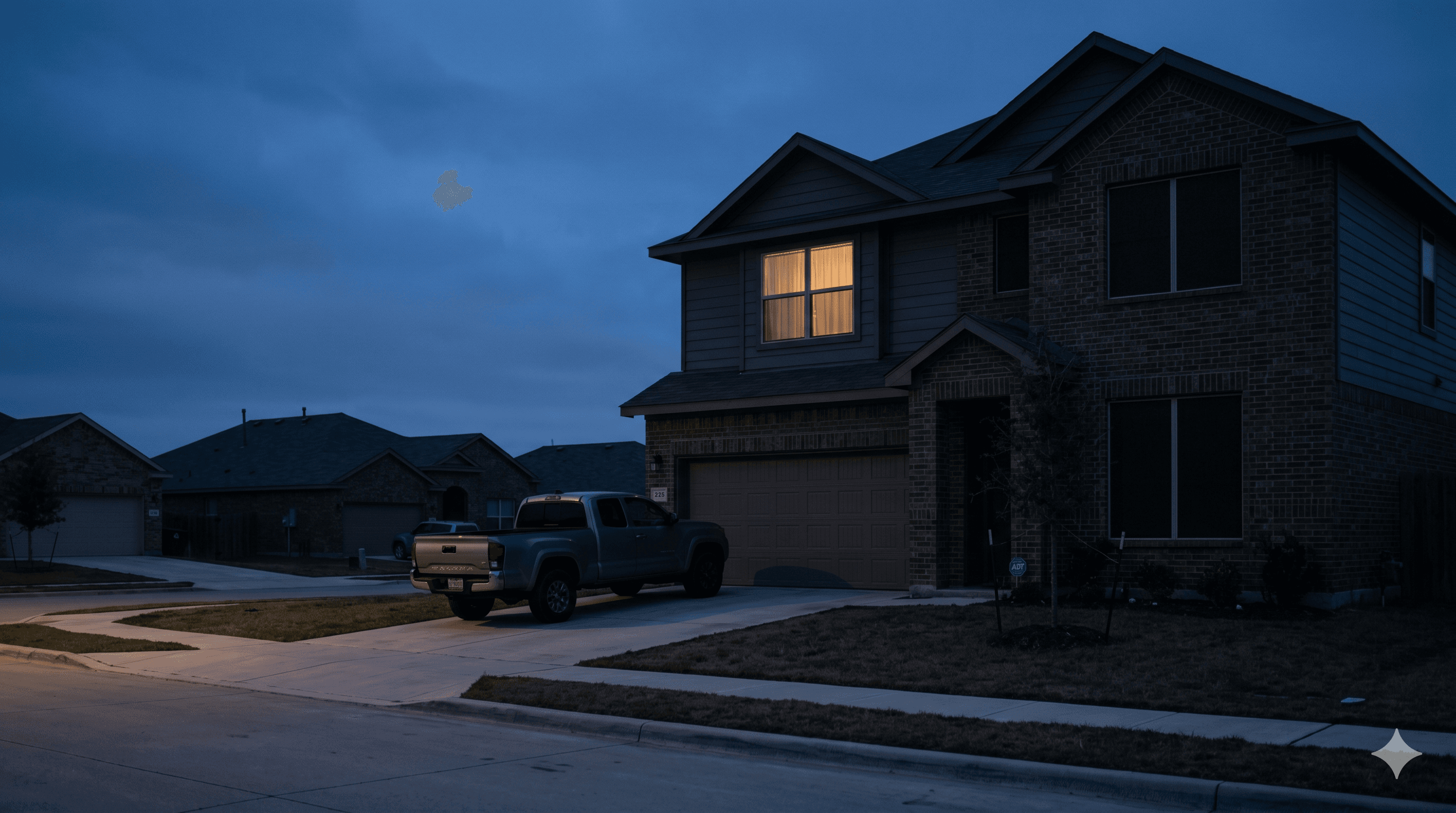
The neighbor's truck was in our driveway when we landed. That was the plan. He'd been moving it twice a day for the week we were in Glacier — sometimes at the curb, sometimes in front of the garage, once backed in like he was loading a cooler. Kitchen lights cycled on a different schedule every evening. Trash cans went out Tuesday and came in Wednesday morning. To anyone casing the street, the house had been lived in. That is the entire game of vacation hardening: making your home an attractive target zero during the exact week the burglar is hunting for the opposite — a confirmed-empty house with mail piling up and a dark window line.
Most home defense planning quietly assumes someone is home. Vacation removes every one of those variables. The UNC Charlotte burglar study — 422 incarcerated offenders interviewed across three states — found that about 83% of burglars try to determine whether an alarm or occupants are present before entering, and roughly half abandon the attempt when they detect either signal (UNC Charlotte / Joseph Kuhns study). FBI Uniform Crime Report data shows July and August consistently rank as the worst months for residential burglary, with December close behind during the holiday travel window (FBI UCR summary; FBI Crime Data Explorer). The average burglary still takes under ten minutes. Vacation is the burglar's high season because it is the only window where the occupancy question answers itself.
This is the pre-departure doctrine — OPSEC, alarm config, false-presence signals, neighbor coordination, physical hardening, remote monitoring. Echelons of Defense is the broader frame; vacation hardening applies that model with the assumption that your interior echelon is empty.
In this article
- Vacation Hardening: How to Leave Without Leaving Your House Vulnerable
- Pre-departure OPSEC: start two weeks out
- Alarm-system pre-departure configuration
- False-presence signals — make the house look lived in
- The neighbor coordination plan
- Physical hardening before you leave
- Remote monitoring — and the security of remote monitoring itself
- The first 48 hours after return
- The vacation hardening checklist
Pre-departure OPSEC: start two weeks out
OPSEC for travel is information discipline. The textbook ABC News case began with a single Facebook post — the family posted a "just landed at the hotel" status, a contact recognized the address, and a U-Haul backed up to the empty house within hours (ABC7 News case). A UK survey of ex-burglars found 78% admitted using social media to scout targets. The gray man doctrine applies as much to your travel calendar as to what you wear in public — see OPSEC for Homeowners.
Social media silence — and a 14-day rule
- No "going on vacation" posts. No passport pics, airport selfies, or hotel check-ins. Post after you return.
- Family follows the same rule. Your sister-in-law tagging you in a Disney photo broadcasts the same data.
- Location services off on every family device — especially teens. Snap Map, Find My Friends visibility, and Instagram location tags paused. Teens leak the most location data in the household.
Limit the verbal spread
- Don't tell strangers your dates — hairdresser, postal carrier, contractor, rideshare driver. The contractor especially knows your alarm placement.
- One trusted neighbor is the limit. Anyone else gets a vague "out of town for a bit."
Mail, packages, and curbside tells
- USPS Hold Mail — free, 3 to 30 days, at holdmail.usps.com. Schedule to start the day after you leave.
- Pause Amazon Subscribe & Save and recurring deliveries. A stack of unopened boxes on the porch is the cleanest "no one home" signal.
- Reroute important deliveries to a neighbor, PO box, or Amazon Hub locker.
- Lawn service — schedule one mow on trips longer than 10 days.
- Trash discipline. Don't put cans out the night before — that is a 36-hour countdown. Neighbor handles pickup day.
Alarm-system pre-departure configuration
Every modern panel — ADT Command, Vivint, Ring Alarm Pro, SimpliSafe, Brinks Home, Guardian — has some form of vacation or extended-away mode. The function is similar: arm perimeter + interior, run light schedules, tighten alert thresholds so a single sensor trip generates a real notification. Pick the right system first — system comparison and monitored-system breakdown.
Vacation mode by platform
- ADT Command — "Away" arming with a "Custom" scene for light schedules + smart-lock lockdown.
- Vivint — "Vacation" geofence override; disables auto-disarm so the panel doesn't drop arming because your phone lit up the geofence from 1,800 miles away.
- Ring Alarm Pro — "Away" mode plus Modes automations; enable 24/7 backup internet on the base station.
- SimpliSafe — "Away" mode plus "Secret Alerts" on key interior sensors. Backup contact in the monitoring center.
Cellular backup and comms redundancy
Two is one, one is none. Wi-Fi-only panels go silent the first time your ISP blips. Confirm cellular backup is active, the SIM is provisioned, and run a comms test before you leave. Communications redundancy covers the PACE plan (Primary, Alternate, Contingency, Emergency) for home comms — vacation is exactly when it matters.
Alert routing and the 48-hour pre-flight
- Aggressive notifications. Real-time push for every door, window, and porch motion event during the trip.
- Backup contact on the monitoring company's call list — neighbor or local family. The monitoring center calls you first; if you're on a plane, they need the second name.
- Test every sensor 48 hours before wheels-up. Open every door/window, walk every motion zone. Pre-flight check is two-is-one applied to the system itself.
False-presence signals — make the house look lived in
The goal is not to fool a forensic analysis; it is to fail the burglar's casing checklist. They are looking for confirmation the house is empty. Deny it and most move on.
- Smart light schedules with jitter. Don't fire the kitchen light at 6:30 PM every day for ten days — robotic tell. Vary it: 6:30 Mon, 6:51 Tue, 7:14 Wed. Stagger bedroom and bathroom. A brief bathroom light at 2 AM occasionally is exactly what real households do. Hue, Lutron Caseta, Kasa, ADT, Vivint all support randomization — turn it on.
- TV / radio on a smart plug. Radio playing talk content 6–9 PM behind a curtain is the cheapest force multiplier in the stack. Eight bucks.
- Driveway activity. Neighbor parks in your driveway daily, or backs your second vehicle out and returns as if running an errand. Movement beats light.
- Trash on schedule. Cans to the curb the right day; back in the next day. Neighbor handles.
- Dog noise. Dogs barking from inside at the delivery driver is a textbook occupancy signal. Dogs as force multipliers.
- Disable geofence Arrive/Leave automations. Auto-disarm on phone proximity is great on a normal Tuesday and a disaster the day a family member with the app drives past your house. Vacation = manual only.
- Yard sign visible. The sign at the curb still works — see alarm yard signs as deterrent.
The neighbor coordination plan
The single trusted neighbor is your highest-leverage asset. Brief them like a teammate, not a courtesy.
- Access: a key or temporary smart-lock code (August, Yale, Schlage Encode, Level all support time-bound codes that expire automatically). A temporary alarm user code, not your master.
- Cadence: drive past every 1–2 days at varying times. Bring in mail and packages that slipped through. Water plants. Move the truck.
- Contact tree: your cell, spouse's cell, monitoring company, local police non-emergency, and the property address on paper (their phone may die).
- What to look for: avenues of approach (side gate, back fence, basement window-well), vehicles parked oddly, any flyer or door-hanger left on your knob — a common casing tell. If the flyer is still there in 24 hours, the house reads as empty.
- What to do: if anything looks off, do not enter. Police non-emergency first, then you. The neighbor is not a clearance team.
Physical hardening before you leave
Doors and windows are the delay echelon. Ten extra seconds on each is the difference between a successful smash-and-grab and a burglar who quits. Full doctrine in Door & Window Hardening.
- Every exterior door deadbolted, including garage-to-house. The garage is the soft flank — Garage as Soft Flank.
- Every window pin-locked or sash-secured. Standard sash locks fall in seconds; pin locks add real delay.
- Sliding glass door — dowel in the track and pin lock through the frame.
- Garage door, trips >14 days: disable at the breaker, or engage the "vacation lock" on myQ Smart Garage Hub or LiftMaster Security+ 2.0. Disables the rolling-code radio entirely; cloned remotes do nothing.
- Pet doors locked. Smart pet doors (SureFlap, PetSafe Smart Door) have schedule lock — set permanent locked for the trip.
- Curtains halfway. Fully open clears sightlines and advertises departure; fully closed advertises absence. Halfway is the lived-in default.
- Move valuables for trips >1 week — spare passports, heirloom jewelry, cash reserves, firearms not in a permanent safe — to a bank box or off-site safe.
- Photograph interior + serials before you leave. Insurance claims close 10x faster.
Remote monitoring — and the security of remote monitoring itself
The same app that lets you check the porch from a beach in Mexico is, if poorly secured, the cleanest path into your home for a sophisticated attacker. Full doctrine in Controlling Your Security System Remotely.
- 2FA on the security app, hard requirement. Authenticator app (Authy, 1Password) over SMS — SIM-swap attacks are not theoretical.
- Unique strong password. Password manager, generated, rotated.
- VPN on hotel and airport Wi-Fi. Mullvad, ProtonVPN, IVPN — pick one and have it active before you connect.
- Daily notification scan — five minutes of scrolling motion alerts over breakfast.
- NDAA-compliant cameras with local-only recording (NVR or microSD) as backup to cloud.
- Pre-trip rehearsal — open the app from a coffeehouse Wi-Fi before you leave town. Confirm view, arm, disarm, and 2FA flow end-to-end.
The first 48 hours after return
The trip home is not the end of the operation. The most important inspection happens before you walk through the front door.
- Walk the perimeter first. Windows intact? Doors unforced? Sliding door track undisturbed? Tool marks on the back frame? Any flyer wedged in the door that wasn't there yesterday?
- Scrub footage from the entire trip at 4x or 8x. Look for unfamiliar vehicles, knock-and-walks, repeated drive-bys at odd hours. Casing for a future hit looks like nothing happening — until the third pass.
- Debrief the neighbor. Anyone ask about you? Strange vehicle on the street?
- Resume normal mode. Panel out of vacation mode, light schedules off, geofence automations restored, notifications back to baseline.
- Resume mail and subscriptions. Release USPS hold, restart Subscribe & Save.
- Mental inventory. Walk every room. Burglars sometimes leave subtle traces — drawer slightly open, jewelry box shifted. If anything is off, file a police report immediately. The first 24 hours are decisive.
The vacation hardening checklist
T-minus 14 days
- Brief one trusted neighbor; share dates and contact tree
- Schedule USPS Hold Mail at holdmail.usps.com
- Pause Amazon Subscribe & Save and recurring deliveries
- Confirm 2FA active on security app; confirm cellular backup on panel
T-minus 48 hours
- Pre-flight test every door, window, motion sensor
- Add backup contact to monitoring company call list
- Set vacation light schedules with randomization; disable geofence auto-disarm
- Issue smart-lock temporary code to neighbor; photograph interior + serials
Day of departure
- Deadbolt every exterior door (including garage-to-house); pin-lock every window; dowel + pin on sliders
- Garage breaker off (trip >14 days) or vacation lock engaged; pet doors locked
- Curtains halfway; trash cans inside the garage
- No social media post; arm panel in vacation/away mode
On return — first hour
- Walk perimeter before entering; confirm panel armed; disarm with code
- Scrub camera footage at 4x; debrief neighbor
- Resume normal mode; release mail hold; inventory walk-through
Vacation is the one window where the burglar gets the answer to their hardest question — is anyone home? — for free, unless you make them work for it. The system you spec, the neighbor you brief, the social media silence you hold for 14 days: together they make your house the wrong target on a street where some other house is the right one. Defense in depth, applied to an empty interior echelon.
If you want a hand speccing a vacation-ready stack — cellular plus battery backup, AI cameras with local recording, a monitoring center with a backup contact, a panel with a real vacation mode — we'll build it with you. Spec a system here. Just the gear that holds while you're 1,800 miles away.