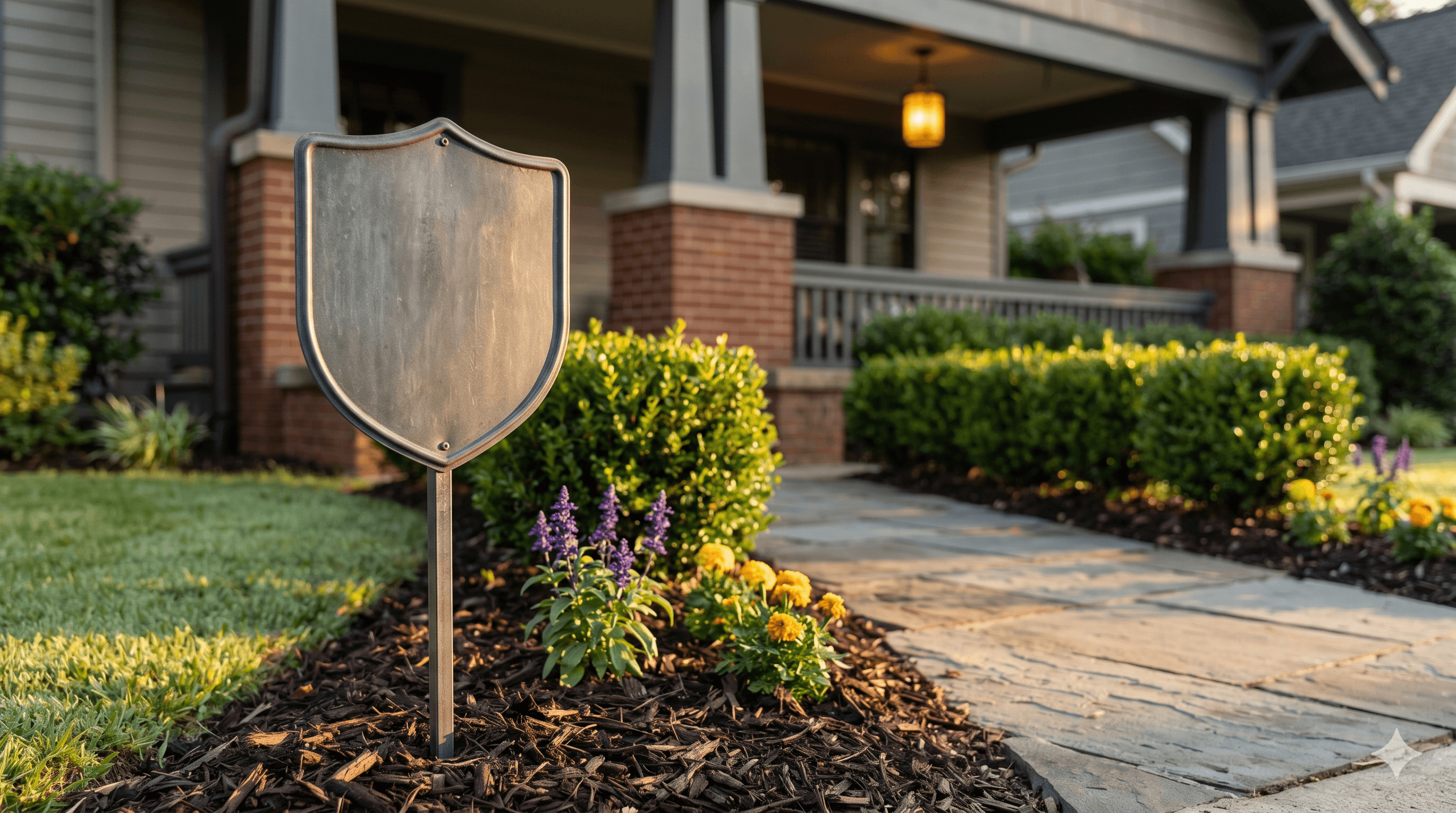
Walk through almost any American neighborhood and you will see them planted in flowerbeds and stuck near front doors: small metal placards advertising ADT, SimpliSafe, Ring, or a generic "This Home Protected by Alarm" message. They cost almost nothing, take ninety seconds to install, and yet homeowners constantly debate whether they actually accomplish anything. So do alarm yard signs really deter burglars, or are they decorative theater? Rather than guess, we went looking for the data, and the most rigorous answer comes from a study that interviewed the people best qualified to answer the question: convicted burglars themselves.
In this article
- How Effective Are Alarm Yard Signs in Deterring Burglars? What the Research Says
- The Study Most Articles Are Quoting (Often Incorrectly)
- Why the Sign Works: Routine Activity and Rational Choice
- What the Broader Burglary Data Says
- Do "Fake" Yard Signs Without a Real Alarm Work?
- Signs Are One Layer in Defense-in-Depth
- What Actually Happens If Someone Tests the Sign
- The Honest Bottom Line
The Study Most Articles Are Quoting (Often Incorrectly)
In 2012, Drs. Joseph B. Kuhns, Kristie R. Blevins, and Seungmug "Zech" Lee at the University of North Carolina at Charlotte completed a research project titled "Understanding Decisions to Burglarize from the Offender's Perspective," commissioned by the Alarm Industry Research and Educational Foundation (AIREF) under the auspices of the Electronic Security Association. Their team surveyed incarcerated burglars selected at random from state prison systems in North Carolina, Kentucky, and Ohio, ultimately collecting 422 usable responses from offenders willing to talk candidly about how they selected, entered, and abandoned targets.
UNC Charlotte's own reporting on the research, "Through the eyes of a burglar," summarized the headline numbers clearly. Roughly 83% of the surveyed offenders said they would try to determine whether an alarm was present before attempting a burglary, and 60% said they would seek an alternative target if they discovered an alarm system on-site. Among those who only discovered an alarm in the middle of an attempt, half reported they would discontinue the burglary, another 31% said they would sometimes retreat, and only 13% said they would always push through and finish the job.
The same study reported that visible signs of a security system, including yard signs, window decals, exterior cameras, and outdoor lighting, were among the top factors offenders considered when selecting or rejecting a target, alongside the obvious presence of dogs inside and the perceived risk that a neighbor or passerby was watching. In other words, the sign in your yard is not a placebo to the people it is meant to scare off. It is one of the specific cues they are scanning for.
Why the Sign Works: Routine Activity and Rational Choice
These findings align almost perfectly with decades of environmental criminology. Lawrence Cohen and Marcus Felson's 1979 routine activity theory argues that crime happens when three things converge in time and space: a motivated offender, a suitable target, and the absence of a "capable guardian." Anything that signals a guardian is present, whether a person, a dog, a camera, or a yard sign that implies a monitored alarm, raises the perceived cost of offending and shifts the offender's calculation.
Closely related is the rational choice perspective associated with Felson, Ronald Clarke, and the broader field of situational crime prevention, curated by the ASU Center for Problem-Oriented Policing. Most residential burglars are not master criminals; they are opportunists who weigh a quick mental risk-reward calculation in the moments before committing to a target. They prefer empty houses, easy entry points, fast escape routes, and low chances of being identified. A yard sign tells them this house may have monitored detection, that police could be dispatched, and that the time window for a quiet smash-and-grab just shrank. For an offender comparing your house to the unmarked one three doors down, that is often enough to move on.
What the Broader Burglary Data Says
Burglary in the United States has been declining for years, but it remains common enough to plan around. The Bureau of Justice Statistics tracks burglary and household property crime through the National Crime Victimization Survey, and the FBI's Uniform Crime Reporting program publishes annual figures on burglary incidents and clearance rates. Two patterns matter for the yard sign discussion:
- Most burglaries are unsolved. Property crime clearance rates sit in the low double digits, which means prevention does far more work than prosecution ever will.
- Most burglaries are short, opportunistic, and target unoccupied homes. Offenders interviewed in the UNC Charlotte study and in earlier work by criminologists such as Richard Wright and Scott Decker repeatedly described spending only a few minutes inside and abandoning the attempt at any unexpected sound, light, or alarm.
When the entire criminal model depends on speed, anonymity, and surprise, a sign that promises noise, lights, and a 911 dispatch directly attacks all three.
Do "Fake" Yard Signs Without a Real Alarm Work?
This is where readers usually want a clean answer, and the honest one is: partially, with diminishing returns, and only if you are very disciplined about the rest of your setup.
The case for fake signs
Burglars in the UNC Charlotte study cannot tell, from the curb, whether the sign in your lawn is backed by a real subscription or whether the inside of the house is wired to a monitoring center. They are reading a signal. If the signal is plausible, it does its work in the few seconds the offender spends evaluating your house. A generic but realistic-looking sign from an unknown brand can plausibly raise perceived risk just like a branded one, particularly for the opportunistic offender who is not going to roll the dice on a maybe.
The case against relying on them
There are real limits. Experienced offenders learn to recognize generic decoy signs, and a sign that does not match any visible hardware (no sensors on windows, no doorbell camera, no exterior siren) can actually signal the opposite of what you intended: that the homeowner is bluffing because they have nothing else. A sign on its own also does nothing if the burglar decides to test you. There is no siren, no monitored response, and no recorded evidence afterward. Roughly 13% of the surveyed offenders said they would push on through an alarm anyway, and a fake sign gives those people zero friction.
In short, a fake sign can buy you a meaningful sliver of deterrence on the cheap, but it is fragile. A real, monitored system, even an inexpensive one, gives you both the deterrent and the response if deterrence fails. Our guide to self-monitored versus professionally monitored security walks through how those two layers actually behave when something goes wrong.
Signs Are One Layer in Defense-in-Depth
The biggest mistake homeowners make is treating the yard sign as the strategy. It is not. It is the cheapest layer in a layered approach. Security professionals borrow the term "defense-in-depth" from cybersecurity for a reason: no single control should be load-bearing, because every control eventually fails against the right offender. A solid residential approach stacks several inexpensive deterrents so that an opportunist hits friction at every step.
- Visible signage and decals at the curb and on side and rear windows so the signal is unavoidable from any approach.
- Exterior lighting, ideally motion-activated, on every dark side of the house.
- A video doorbell or visible exterior camera that confirms the sign is not a bluff.
- Reinforced entry points: solid-core doors, longer strike-plate screws, and secondary window locks.
- A real alarm system with door, window, and motion sensors connected to either self-monitoring or a professional monitoring center.
- Routine cues of occupancy: smart bulbs on schedules, mail held when traveling, and trusted neighbors who notice the unfamiliar car.
Each item is cheap on its own. Stacked, they make your home a categorically worse choice than the unmarked house nearby. If you want to see how the major systems compare on this layered approach, our best home security systems comparison breaks down which platforms include yard signage and decals by default and which charge extra.
Renters Are Not Off the Hook
Yard sign deterrence is not just for owners. Apartment dwellers and tenants benefit from visible signaling too, even if it is a window decal rather than a stake in the lawn. We cover practical options in our guide to security systems for renters.
What Actually Happens If Someone Tests the Sign
A yard sign's job ends the moment a determined offender decides to ignore it. After that point, the question becomes how quickly the rest of your system responds. Sirens, monitoring center callbacks, and police dispatch all operate on a clock measured in seconds and minutes. We walk through that timeline in detail in our piece on what happens when a home security alarm goes off, including how monitoring centers verify the event and how dispatch priorities work.
The combination matters. A sign deters the casual offender. A real alarm punishes the determined one. The UNC Charlotte numbers describe both halves of that picture: 60% will simply leave when they spot the sign and the alarm, and another large share will abandon the attempt mid-burglary if the alarm activates.
The Honest Bottom Line
Yard signs and window decals are one of the highest return-on-effort items in residential security. The Kuhns / Blevins / Lee research for AIREF is the strongest evidence we have that visible alarm signaling genuinely changes offender behavior, with roughly six in ten burglars saying they would walk away from a marked target and only about one in eight saying they would always finish the job once an alarm activated. Routine activity theory and rational choice theory both explain why: you are raising the perceived risk and shrinking the offender's time window, which is exactly the calculus they care about.
But signs are a layer, not a plan. A sign with no system behind it is a bluff that some offenders will eventually call. A sign backed by sensors, cameras, lighting, and a monitored response turns your house into the option burglars skip on their way to an easier one.
If you want a custom recommendation that pairs a visible deterrent strategy with a real monitored system sized to your home, neighborhood, and budget, our concierge team can do the legwork for you. Get matched with the right home security setup here and put more than just a sign between your family and the next opportunist who walks down your street.