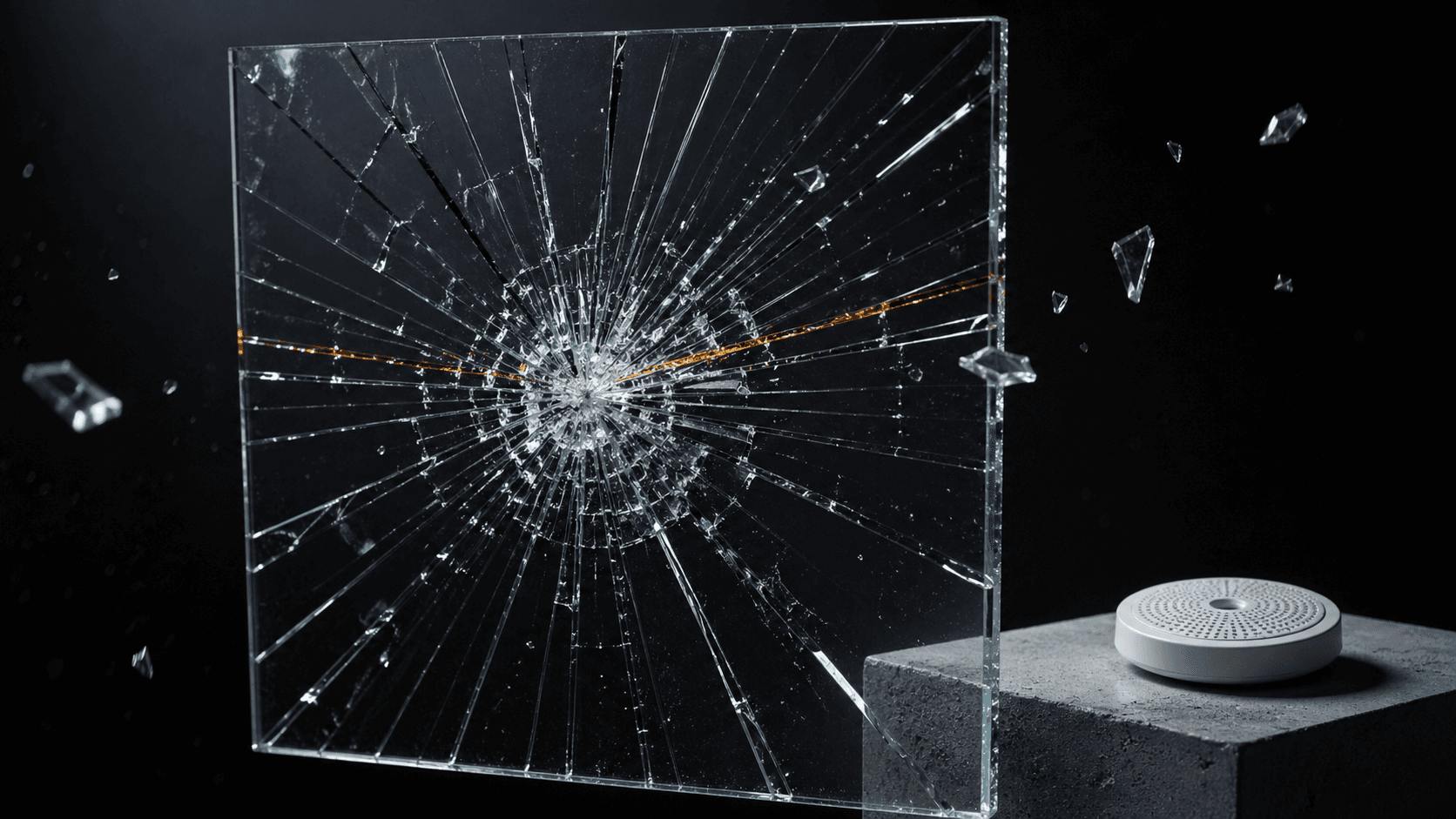
It is 3:07 AM. A man in dark clothes is standing in the side yard of a ground-floor bedroom window. He has cased the house twice in the last week, and he has decided tonight is the night. He swings a center punch into the lower pane. Glass shatters. He reaches in, flips the latch, slides the window up, and steps inside. From the moment the punch contacts the glass to the moment his second boot hits the carpet: about ten seconds.
Now look at where your sensors are. The PIR motion detector in the hallway is pointed inward, sweeping the carpet outside the bedroom door. It will not see him until he steps out of the bedroom — somewhere around second fourteen or fifteen. By that point he is already inside the house, already armed if he came armed, already past the perimeter. Your motion sensor is not an early-warning system at that point. It is a witness.
This is the gap that a glass break sensor closes. A properly placed acoustic glass break detector trips on the shatter itself — second one, not second fourteen. That seven-to-thirteen second delta is not a rounding error. It is the entire reaction window: the time you have to come out of REM sleep, identify the threat, get to the hard room, and get hands on a phone and a defensive tool. Skip the glass break layer and you have given that window away.
And most homeowners have given it away. Walk into a typical big-box DIY security kit — door contacts, a couple of PIRs, a doorbell camera, maybe a panel — and there is no glass break sensor in the box. Industry installers estimate the majority of consumer packages ship without one. That is the missing layer. This piece is about what it is, how the technology actually works, where to put it, and how to keep it from crying wolf.
In this article
- Glass Break Sensors: The Sensor Layer Most Homeowners Skip
- Why Glass Break Is the Detection Echelon Most Systems Skip
- The Two Glass-Break Detection Technologies
- False-Alarm Management — Why Acoustic Used to Have a Bad Reputation
- Placement Doctrine — Where the Sensor Actually Goes
- Integration With the Rest of the Stack
- Why Preppers in Particular Should Layer Glass Break In
- Specific Buyer Recommendations by Use Case
- What to Watch Out For When Buying
- Spec Checklist for a Typical Home
- The Layer You Cannot Afford to Skip
Why Glass Break Is the Detection Echelon Most Systems Skip
Defense in depth — what we call echelons of defense — works because each layer buys time and forces the attacker to defeat something before reaching the next one. Yard signs and lighting work on selection. Locks and reinforced strikes work on delay. Sensors work on detection. Cameras and audible alarms work on response. Pull any one of those layers and the chain weakens, but pull the first detection echelon and the whole reaction window collapses.
The UNC Charlotte burglar study — 422 incarcerated offenders interviewed across three states — is one of the most quoted pieces of research in the residential security trade for a reason. Roughly 60% of the offenders said an alarm on-site would push them to an alternative target, and the average time inside a target home was short — many burglars cited under ten minutes, with experienced offenders working in five (UNC Charlotte, 2013). FBI Uniform Crime Reporting data has historically shown that windows account for a meaningful share of forcible-entry residential burglaries — typically a quarter to a third, depending on the year and dataset (FBI Crime Data Explorer).
Translation: a sizable share of burglars come in through glass, and the ones who do are inside and gone faster than your average shower. PIR motion sensors looking inward cannot help you against that timeline. Two is one, one is none. Glass break is the sensor that fires while the attacker is still outside the wall.
The Two Glass-Break Detection Technologies
There are two real ways to detect a window break, plus a hybrid. Each has tradeoffs. A serious system uses both where it matters.
Acoustic Glass Break Sensors
Acoustic detectors are room-level sensors — usually mounted on the ceiling or on the wall opposite the windows — that listen for the unique sound signature of breaking glass. Modern units do not just listen for "loud noise." They run digital signal processing (DSP) on the audio stream and look for two events in sequence: a low-frequency thud (roughly 60-200 Hz) of an object striking glass, followed by the high-frequency shatter cluster (roughly 2-5+ kHz) of the pane fragmenting. Both have to occur in the right order, within the right time window, with the right amplitude curve. That dual-pattern requirement is what gives modern acoustic sensors their false-alarm immunity.
Coverage radius is typically 15 to 25 feet from the sensor, line-of-sight, with the rated radius derived from the manufacturer's frame-glass-distance test. Names integrators trust:
- Bosch DS1101i and DS1108i — the integrator gold-standard. The DS1108i is the higher-end unit with extended coverage, dual-pattern detection, and FlexCore signal processing. Bosch publishes detailed coverage diagrams (Bosch Building Technologies).
- Honeywell FG-1625 and FG-1625F — long-time staple in Vista panel installs. The "F" variant is flush-mount. Resideo continues to support the line (Resideo / Honeywell Home).
- Optex FlipX and Quad Sound Discriminator — Optex is best known for outdoor PIR/microwave dual-tech, but their indoor sound discriminators are well-regarded.
- 2GIG GB1 — wireless, panel-friendly for 2GIG/Alarm.com installs.
- Ring Glass Break Sensor — entry-level, integrated with Ring Alarm. Acceptable for the DIY tier; not in the same class as a Bosch or Honeywell unit on a wired panel.
Shock and Vibration Sensors
Shock detectors are small piezo-electric units mounted directly on the window frame or — for high-value windows — on the pane itself. They do not analyze audio; they feel the impact vibration in the glass and frame. The trip happens at the moment of impact, before the glass has even finished shattering, so trip time is faster than acoustic. They are also less prone to environmental false alarms — a vacuum cleaner does not vibrate the window pane, so the sensor does not care.
The tradeoff is per-window mounting and calibration. One acoustic sensor covers a room; a shock sensor covers exactly the pane it is glued to. Names worth knowing:
- GRI shock sensors — long-time commercial favorite, multiple sensitivity profiles.
- Honeywell 5853 — wireless supervised shock-and-acoustic combo, encrypted, 5+ year battery on a 3V CR123. Pairs with Vista and ProSeries panels.
- DSC SD-15 / SD-15WL — wired and wireless shock sensors that pair with PowerSeries and PowerSeries Neo panels (DSC).
Dual-Tech (Acoustic + Shock, or Acoustic + Microwave)
A dual-tech glass break sensor requires both technologies to trip in sequence before it sends an alarm. Vibration and sound. Or sound and a confirmed motion event. False alarms drop to near-zero. Cost goes up, and you are now buying a small sensor system per opening rather than a single ceiling unit per room. Worth it on the master bedroom and on the ground-floor windows that face the street and the alley.
False-Alarm Management — Why Acoustic Used to Have a Bad Reputation
Older single-pattern acoustic detectors triggered on dropped dishes, vacuum motors, dogs barking at the mail truck, kids screaming, even certain TV speaker frequencies. Integrators in the 1990s and early 2000s pulled them out of installs because the call-out rate was unacceptable. That is the era a lot of homeowner skepticism comes from, and the technology is not the same anymore.
Dual-pattern DSP — thud first, shatter second, both in the right time window — virtually eliminates the legacy false-alarm sources. But you still have to use your head about placement and environment:
- Kitchens — clinking glass plates and dropped wine glasses can put the sensor under repeated stress. Mount carefully or use shock sensors on the kitchen windows instead.
- TV rooms — movie audio with breaking-glass effects has tripped lesser sensors. Modern Bosch and Honeywell units filter for the physics of real shatter, but verify before you commit.
- Windy areas — branches striking the window can fool a shock sensor. Trim the branches.
- HVAC ducting near the sensor can resonate and elevate background noise. Move the sensor.
The most powerful false-alarm mitigation is not in the sensor itself — it is in the correlation logic on the panel. Configure the system so the acoustic glass break primes the room PIR. If the glass break fires alone, log it. If the PIR confirms motion in the same room within 30 seconds, escalate to alarm. If the PIR confirms and a camera registers a person, dispatch. That layered logic — what we cover in motion sensors as early warning and how motion sensors work alongside cameras — is how you get sensitivity without nuisance trips.
Placement Doctrine — Where the Sensor Actually Goes
A glass break sensor pointed at the wrong wall is a decoration. The doctrine is straightforward but unforgiving:
- One acoustic sensor per room with windows, mounted on the ceiling or on the wall opposite the windows, within the manufacturer's rated radius (typically 15-25 ft for premium units, less for budget gear).
- Line-of-sight matters. Heavy curtains, room dividers, deep window wells, and corners will absorb the high-frequency shatter cluster and cut effective range. Bosch and Honeywell publish coverage diagrams — use them, do not eyeball it.
- Avoid sources of false alarm. Do not mount over the kitchen sink, near TV speakers, near HVAC vents, or in laundry rooms.
- Shock sensors per high-value window. Master bedroom, ground-floor accessible windows, basement egress windows, and French doors get a shock sensor on top of the acoustic room coverage. Two layers per critical opening.
- Sliding glass doors are a special case. They are simultaneously a door and a giant pane of glass. Hardening dictates a door contact plus a shock sensor on the pane plus acoustic coverage in the room — see the companion piece on door and window hardening as the delay echelon.
- Verify with a tester. Bosch, Honeywell, and Optex sell handheld glass break testers that simulate the dual-pattern signature. Walk every room before you call the install done.
Integration With the Rest of the Stack
A sensor is an input. What matters is what the panel does with it. Your glass break layer should integrate with the rest of the system the way a fire-team weapon integrates with the squad — under common command, on a supervised line, with redundant comms.
- Wire to the panel where possible. Honeywell Vista, DSC PowerSeries Neo, and Bosch B/G Series panels all accept zone inputs from wired glass break detectors. Wired sensors do not run out of battery and are harder to defeat. Mind the cable distance limits and use end-of-line resistors for supervision.
- Wireless options must be supervised. The Honeywell 5853, DSC PG9912, and 2GIG GB1 are encrypted, supervised (panel polls them, reports tamper and low battery), and acceptable for primary detection. Unsupervised wireless sensors do not report when they go silent — that means a dead battery is invisible until the night you need them. Avoid unsupervised gear for primary detection.
- Cellular plus battery backup at the panel. Glass break is meaningless if the panel cannot dispatch. A cellular communicator with a 24+ hour battery means the alarm survives an ISP outage and a power outage. We go deeper on this in communications redundancy for grid-down home defense.
- Remote control and notification. A modern panel should push an alert to your phone, log to local storage, and let you arm/disarm zones from anywhere. See remote panel control for the architecture.
- NDAA compliance. The NDAA Section 889 issue is mostly about Hikvision and Dahua cameras, not sensors — but verify your camera brands separately. Bosch, Honeywell, DSC, 2GIG, and Optex sensors are not affected.
Why Preppers in Particular Should Layer Glass Break In
If you are reading this, you have already internalized that the goal is not "deter casual theft." The goal is time-to-target advantage — buying the seconds it takes to identify, decide, and act before an unknown person is in your living room. Glass break earns its keep four ways:
- Time advantage. Six to ten seconds of additional warning is the difference between "engaging from the hard room" and "encountering in the hallway." That is not a marginal upgrade; it is a different fight.
- Dead-space coverage. Basements, kids' rooms with PIR turned off for privacy, attached sunrooms, garages. Rooms a PIR cannot watch are rooms a glass break sensor still covers.
- Failure-mode complement. If your PIR is defeated, fooled, masked, or simply fails, the glass break sensor is on a different physical channel — sound, not infrared. Two means of detection means defeating one does not defeat the system. Two is one, one is none.
- Detection without exposure. The audible siren and panel alert give you situational awareness from inside the hard room. You do not have to clear the house. You do not have to investigate. You confirm the breach point from the panel app and you stay put.
This is the same logic behind layered door chimes for the OODA loop — a force multiplier sits on early warning, not on confrontation.
Specific Buyer Recommendations by Use Case
Suburban Single-Family With a Monitored Panel
Bosch DS1108i acoustic sensor on each level (one per major room with windows), plus Honeywell 5853 shock sensors on the master bedroom window and every ground-floor accessible window. Wire to a Honeywell Vista or DSC PowerSeries Neo panel with cellular communicator and 24-hour battery. Correlate with a dual-tech PIR per room. Budget: $400-700 in sensors, plus install.
DIY User on SimpliSafe or Ring Alarm Pro
Use the factory glass break sensor for ecosystem compatibility — Ring Glass Break Sensor with Ring Alarm Pro, SimpliSafe Glassbreak Sensor with the Gen 3 panel. Be honest with yourself: these are entry-level acoustic units, not Bosch DS1108i. Dual-pattern detection is present but the rated coverage is shorter and the false-alarm rejection is not the same. Compensate by adding shock sensors on the critical windows. See our best-systems comparison for ecosystem tradeoffs.
Off-Grid or Cellular-Only
Wireless supervised acoustic sensor with documented battery life. Honeywell 5853 (5+ years on a CR123), Bosch wireless equivalents. Pair with a panel that has cellular plus solar/battery backup. Verify supervision interval — you want the panel polling the sensor at least every few hours.
Renter
You cannot drill the landlord's window frames. Use wireless adhesive-mount shock sensors and a tabletop or adhesive-mount acoustic unit. Battery-powered, supervised, and removable when the lease ends. We covered this kit in best security systems for renters.
What to Watch Out For When Buying
- Single-pattern legacy acoustic sensors. If the spec sheet does not say "dual-pattern" or "thud-and-shatter detection," it is probably old generation. False-alarm magnet. Skip it.
- No-name shock sensors. Calibration is everything on a piezo. A $4 unbranded sensor from an overseas marketplace will either trip on the cat or not trip on a center punch. Stick with GRI, Honeywell, DSC.
- "Smart speaker" pseudo-detection. Alexa Guard and similar features that listen for breaking glass through a smart speaker are better than nothing in a room you would otherwise leave uncovered, but they are not a substitute for a wired or supervised sensor on a panel. Cloud-dependent, no local siren if internet is out, no panel correlation.
- Cloud-only detection that cannot fire the local siren if the internet is out. If your sensor's only path to the alarm bell goes through a server in Virginia, an ISP outage disarms your house.
- Batteries you cannot field-replace. Sealed-battery sensors with 2-year life are a maintenance trap. Buy CR123 or AA-replaceable units with 5+ year rated life.
Spec Checklist for a Typical Home
If you take one thing away from this piece, take this list. Print it, walk your house, mark the gaps:
- One dual-pattern acoustic glass break sensor per level, per room with windows. Bosch DS1108i or Honeywell FG-1625 class.
- Shock sensors on the master bedroom window and every ground-floor accessible window. Honeywell 5853 or DSC SD-15.
- Wired-to-panel where construction allows; supervised wireless where it does not.
- Correlation logic with PIR and camera in the same room — glass break primes, PIR confirms, camera verifies.
- Panel with cellular communicator and 24+ hour battery backup.
- NDAA-compliant brands throughout (sensors are mostly fine; verify cameras separately).
- Annual walk-test with a manufacturer glass-break tester. Replace batteries on a schedule, not on a low-battery alert.
The Layer You Cannot Afford to Skip
Glass break sensors are the cheapest seven seconds of warning you will ever buy. A few hundred dollars of dual-pattern acoustic detectors and shock sensors, integrated with a panel you already own, turns the window from a soft entry point into a tripwire. The attacker does not get to be inside before the alarm fires. You do not have to investigate the noise that woke you. You go to the hard room, you look at the panel, you call dispatch, and you stay put while the system does its job.
If you are still working from a kit that came in a box and ships with door contacts and a doorbell camera, you are missing the layer. Add it.
If you would like a second set of eyes on your sensor plan — glass break placement, PIR correlation, camera coverage, panel and cellular backup, all specified to your floor plan and your threat model — spec a layered system with us. No upsell, no canned package. Just the right sensors in the right rooms, wired to a panel that survives a power cut and a dead ISP.