Walk into any big-box electronics store and you will find a wall of smart-home security gadgets: doorbells with cameras, locks with keypads, sensors that promise to text you when something moves. Most homeowners buy them one at a time, hoping the pieces will somehow add up to a secure house. They rarely do. A pile of disconnected devices is not a security system; it is a collection of notifications.
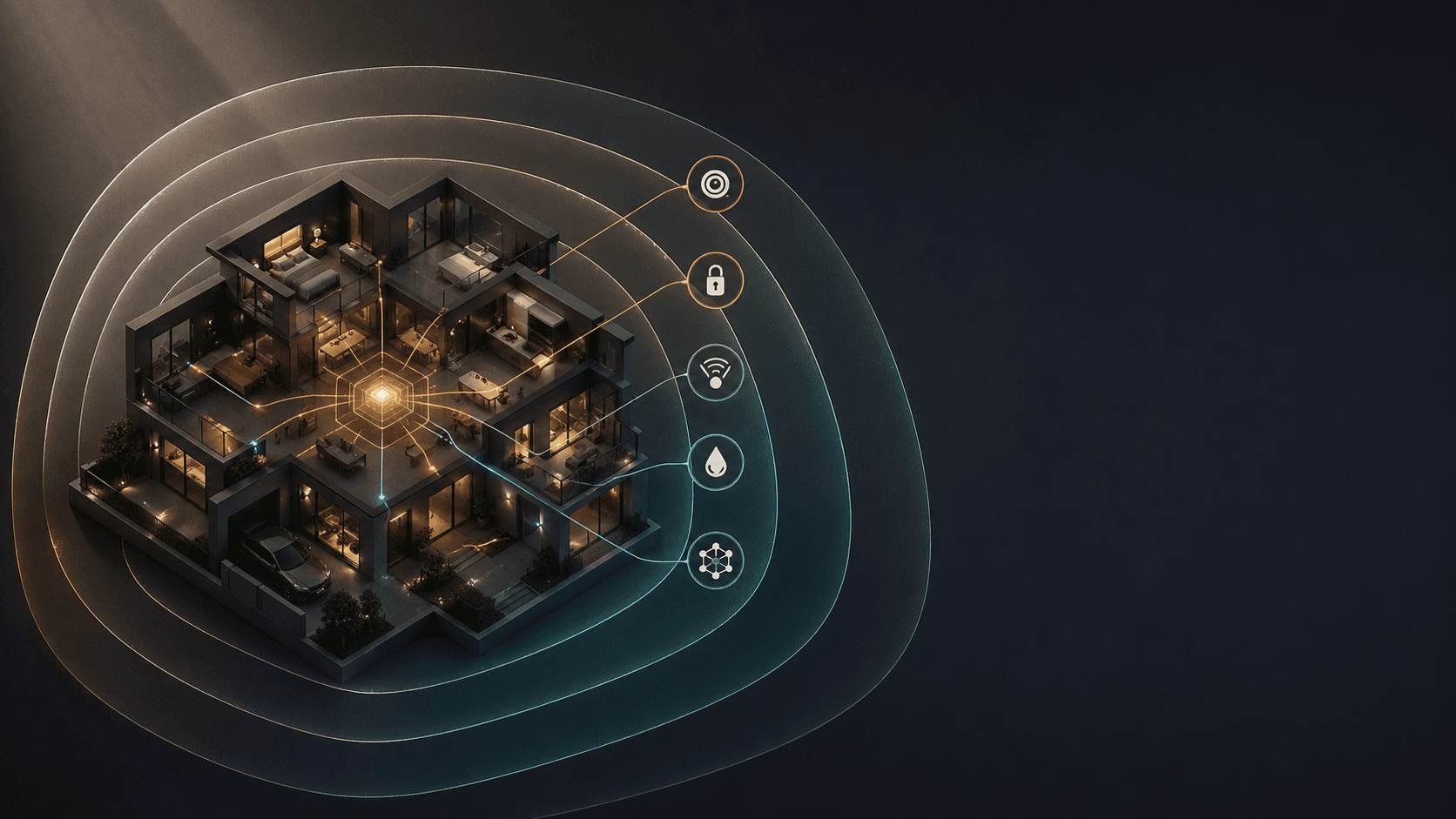
The better mental model is to think like an architect, not a shopper. A real smart-tech home defense is a five-layer stack, where each tier handles a specific job and every device speaks to the others through a common language. Done right, the stack catches threats early at the perimeter, hardens entry points, watches the interior, monitors environmental hazards, and ties everything together with reliable orchestration. Done poorly, you end up with five apps, three voice assistants, and a doorbell that cannot tell your smart lock the package was just delivered.
Below is the layered approach we use when we help homeowners design a coherent system, with a working knowledge of the interoperability standards (Matter, Thread, Zigbee, Z-Wave) and platform choices (Apple Home, Google Home, Alexa, SmartThings) that determine whether your gadgets will still play nicely together five years from now.
Layer 1: The Perimeter
The outermost layer is your yard, driveway, and the airspace around the house. Its job is detection and deterrence before anyone reaches a door or window. Cameras and lights belong here, not inside.
Outdoor cameras and motion-activated lighting
- Outdoor cameras with wide dynamic range, color night vision, and on-device person/vehicle detection. AI filtering matters more than megapixels here, because a camera that cries wolf at every cat is one you will mute within a week.
- Motion-activated floodlights, ideally integrated with the cameras so a triggered light becomes a triggered recording.
- Driveway and yard sensors for early warning before anyone reaches the porch.
Perimeter gear is most effective when it is visible. Deterrence is half the value, which is why a well-placed camera with clear line-of-sight matters more than a hidden one. We unpack what good detection looks like in our overview of home security technology trends for 2026.
Layer 2: Entry Points
If the perimeter is the fence, this layer is the gate. Roughly a third of burglars enter through the front door, so this is where smart hardware earns its keep.
Smart locks, video doorbells, and contact sensors
- Smart locks with auto-lock, unique user codes for family and service workers, and tamper alerts. Look for ANSI/BHMA Grade 2 or higher physical hardware; software is meaningless if the deadbolt is flimsy. Our complete guide to smart locks for the front door walks through the specific certifications and connectivity options.
- Video doorbells with package detection, two-way audio, and a head-to-toe field of view so you can see a person and what they are holding.
- Door and window contact sensors on every ground-floor opening and any second-floor window reachable from a roofline.
The magic at this layer is automation. A doorbell ring at 2 a.m. should not just chime; it should wake your phone, light the porch, and start recording from the driveway camera at the same time. That orchestration only works if your devices share a standard, which is exactly why Layer 5 matters so much.
Layer 3: Interior Awareness
If the perimeter or entry layer is bypassed, the interior layer catches it. This is also where the most common mistake happens: people stack indoor cameras everywhere without thinking about privacy, blind spots, or false-alarm fatigue.
Motion, glass-break, and indoor cameras
- PIR motion sensors in hallways and common spaces, with pet-immune settings if you have animals.
- Glass-break sensors near large windows and sliding doors. They listen for the specific frequency of breaking glass, so a single sensor can cover a whole room.
- Indoor cameras with a privacy shutter and a clear "home/away" mode so they only stream when you are out.
Interior cameras are the most privacy-sensitive devices in the stack. Choose a platform like Apple Home that encrypts video end-to-end, or insist on local-only recording for any camera that watches a bedroom or kid's space.
Layer 4: Environmental Hazards
The most likely event to damage your home is not a burglar; it is water, smoke, or carbon monoxide. A smart-tech stack that ignores this layer is half a system.
Smoke, CO, water, and freeze sensors
- Interconnected smoke and CO detectors that alert your phone and the monitoring service, not just the room they are in.
- Water leak sensors under sinks, behind washing machines, near water heaters, and at the base of toilets.
- Freeze and temperature sensors, especially for second homes or vacation periods.
- Smart water shutoff valves that close the main line automatically when a leak is detected.
Insurance carriers increasingly offer credits for water and freeze sensors because the claims math is overwhelming. If you only invest in one upgrade this year and you live somewhere with hard winters or aging plumbing, this layer may have the highest ROI in the stack.
Layer 5: Orchestration and Standards
This is the layer most articles skip, and it is the one that decides whether your stack is coherent or chaotic. Orchestration is the hub, the automations, the alert routing, and the standards that let devices speak to each other.
Interoperability: Matter, Thread, Zigbee, Z-Wave
- Matter is the IP-based application standard backed by Amazon, Apple, Google, Samsung, and dozens of hardware partners through the Connectivity Standards Alliance. A Matter-certified device is designed to work natively across major platforms without per-vendor integrations. See Connectivity Standards Alliance — Matter.
- Thread is the low-power IPv6 mesh that runs underneath Matter for many battery-powered sensors and locks. It has no single point of failure and is governed by the Thread Group.
- Zigbee and Z-Wave are the older mesh radios that still power millions of sensors and locks. They work well, but they require a hub that speaks their dialect.
- Wi-Fi devices are easy to set up and notoriously hungry for power and bandwidth. Reserve Wi-Fi for cameras and high-throughput devices; use Thread or Zigbee for the small stuff.
Platform lock-in: Apple Home, Google Home, Alexa, SmartThings
Choosing a primary platform is a real decision. Apple Home is the strictest about privacy, with end-to-end encryption and HomeKit Secure Video for compatible cameras when paired with iCloud+ and a home hub. Google Home and Amazon Alexa lean on cloud intelligence and the broadest device catalogs. Samsung SmartThings is the most flexible for power users who want Zigbee, Z-Wave, Thread, and Matter under one roof. Most households should pick a primary platform, then prefer Matter-certified devices so a future migration is realistic instead of theoretical.
Hardening the stack
Smart-home devices are computers on your network, and they should be treated like it. The U.S. National Institute of Standards and Technology publishes a baseline of foundational cybersecurity capabilities IoT manufacturers should bake in (NIST IR 8259 Rev. 1, published April 2026), covering identification, configurability, secure updates, and logging. CISA's recent advisory on covert networks of compromised devices is a reminder that home routers and IoT gear are actively targeted at scale. The homeowner-side basics are short:
- Change every default password and use a password manager.
- Turn on multi-factor authentication for the platform account that controls your locks and cameras.
- Put smart-home devices on a separate Wi-Fi network or VLAN from your laptops and phones.
- Keep firmware updated automatically wherever the device supports it.
- Review who has access — old roommates, former contractors, expired guest codes — at least twice a year.
Why a Coherent Stack Beats a Pile of Gadgets
A connected defense is not about owning more devices; it is about owning the right devices in the right layers, talking to each other through standards that will outlast any single product line. The homeowners we see with the best results are not the ones who spent the most. They are the ones who thought in layers, picked a platform, prioritized Matter and Thread where it made sense, and gave environmental sensors the same attention as cameras.
If you are weighing whether to run that stack yourself or have it monitored, our breakdown of self-monitored vs. professionally monitored home security walks through the trade-offs. If you are still narrowing down hardware, the best home security systems comparison covers how today's top providers handle each layer. And if any of this feels like a lot, you are not alone — most of our customers arrive feeling overwhelmed by the options, and the layered framework is exactly how we cut through it.
Build Your Stack with Help
You do not have to design this on your own. Smart Security Concierge maps your home, your priorities, and your budget to a layered stack that uses standards-based hardware and a platform you can actually live with. We make the trade-offs explicit and the pricing transparent — no upsells, no contracts you do not understand. Start your concierge consultation here and we will help you build a connected defense that actually fits your home.